Polynomial Functions and Rates of Change
A polynomial function has a degree and a leading term.
Part 1 · Hook
Why this matters
Part 2 · Before you start
What this builds on
Part 3 · Prerequisite check
Quick check before you start
1. Which is factored completely?
Show the answer
Common factor , then a difference of squares.
- Correct: :
- :
- :
- :
2. The average rates of change of over consecutive equal intervals are . The graph of is
- concave down
- concave up
- decreasing
- linear
Show the answer
Decreasing rates mean concave down.
- Correct: concave down:
- concave up:
- decreasing:
- linear:
Part 4 · See it
See it first
Part 5 · Step by step
How it works, step by step
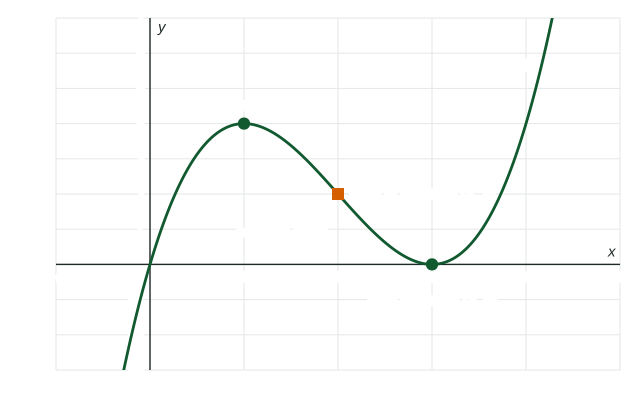
- A polynomial function switches from increasing to decreasing at it has a local maximum at (decreasing to increasing gives a local minimum)
- The domain is limited to a closed intervalan included endpoint can also be a local extremum, so check the endpoints
- You compare every local extremum value and every endpoint valuethe greatest is the global maximum and the least is the global minimum
- The rate of change switches from increasing to decreasing, or backthe graph changes concavity: a point of inflection
Part 6 · Key ideas
Key ideas
- A polynomial function
has degree and leading term . - Local maximum: an output at least as large as at nearby inputs; local minimum: at most as large. Global: over the whole domain.
- Between two distinct real zeros there is at least one local extremum. An even-degree polynomial has a global maximum or minimum.
- A point of inflection is where the graph changes concavity: the rate of change switches from increasing to decreasing, or back.
Part 7 · Misconception
A common mistake
The wrong idea: The global maximum is the largest local maximum.
What actually happens: Check the endpoints too. On , has a local maximum at , but is the global maximum.
Part 8 · Check yourself
Check yourself
Exam-style questions. Anything you miss goes into your review queue.
Graph
The graph of on
1. The function is defined only for . At which inputs does have a local minimum?
- and
- and
- and
Show the answer
A local minimum is where the output is less than or equal to the outputs at nearby inputs: where changes from decreasing to increasing, at and (both with ).
- Correct: and : Right: switches from decreasing to increasing at both.
- : At , switches from increasing to decreasing: a local maximum.
- and : These are local maxima: the output there is greater than at every nearby input.
- and : At the graph is still rising and at it is still falling; it does not turn around at either, so neither is a local minimum.
2. The function is defined only for . What is the global maximum value of on its domain?
No calculator. Type the exact value (a fraction, π, e or a root is fine).
Show the answer
Compare the local maximum values and the endpoint values: ,
- Answer: 5.25
3. The function is defined only for . How many points of inflection does the graph of have?
- One
- Two
- Three
- Four
Show the answer
A point of inflection is where the graph changes concavity. is concave up near , concave down near and concave up near : two switches, at about and .
- One: Look at both sides: the graph changes from concave up to concave down left of and back again right of it.
- Correct: Two: Right: concave up, then concave down around , then concave up again; it switches twice.
- Three: The turning points , and are extrema, not inflection points.
- Four: Count where the bending changes, not where the direction changes.
Graph
Temperature in a greenhouse
4. The temperature in a greenhouse is
Calculator allowed. Give the answer correct to three decimal places, in degrees Fahrenheit.
Show the answer
The maximum feature gives degrees at . Evaluating at a rounded gives , which is not accurate to three decimals.
- Answer: 94.140 degrees Fahrenheit
5. The temperature in a greenhouse is
- is increasing, and the rate of change of is increasing.
- is decreasing, and the rate of change of is decreasing.
- is increasing, and the rate of change of is decreasing.
- is decreasing, and the rate of change of is increasing.
Show the answer
On the graph rises, so is increasing. The hourly changes shrink (about from to , about from to ), so the rate of change of is decreasing: is concave down there.
- is increasing, and the rate of change of is increasing.: The graph bends downward on , so the rates are falling. Compare with .
- is decreasing, and the rate of change of is decreasing.: keeps rising until about .
- Correct: is increasing, and the rate of change of is decreasing.: Right: the temperature rises, but by less each hour as it nears its peak.
- is decreasing, and the rate of change of is increasing.: The temperature rises on ; it falls only after .
6. A polynomial function has zeros at and and no zeros between them. Which must be true?
- is increasing on .
- has a local maximum or a local minimum between and .
- has a point of inflection at .
Show the answer
Between two distinct real zeros, a polynomial function's graph must turn around to come back to the -axis, so it has at least one local extremum there.
- is increasing on .: starts and ends at on , so it cannot rise the whole way.
- Correct: has a local maximum or a local minimum between and .: Right: leaves and comes back to , so it turns around in between.
- : There are no zeros between and .
- has a point of inflection at .: Nothing forces a change in concavity at the midpoint.
Part 9 · Summary
Summary
Part 10 · Up next
What comes next
Part 11 · Connections