
Intervals are how precalculus says "these inputs" or "these outputs". You will write them for domains and ranges, for where a function rises or falls, and for the stretch of inputs a question is about. This page covers the notation and how to solve the linear inequalities that produce intervals.
Interval notation
An interval is every real number between two ends. Write the left end, a comma, the right end, and show whether each end is included:
| Inequality | Interval | Ends |
|---|---|---|
| both included (closed interval) | ||
| neither included (open interval) | ||
| in, out | ||
| in; no right end | ||
| no left end; out |
A bracket means "included", a parenthesis means "not included". The symbols and are not numbers you can land on, so they always get a parenthesis. On a graph, an included end gets a closed dot and an excluded end an open dot.
When a set skips a number, write the pieces and join them with the union sign . Every real number except is .
Solving linear inequalities
A linear inequality, such as , is solved like an equation: add, subtract, multiply or divide both sides by the same number. One rule is different. Multiplying or dividing by a negative number flips the inequality. The reason: , but . Negation turns the number line around.
Worked example 1. Solve .
Subtract from both sides: .
Divide by and flip: . In interval notation, .
Check one value inside: gives , and . Check the end: gives , false, so the parenthesis is right.
Compound inequalities
A compound inequality has three parts, like . Do every step to all three parts at once.
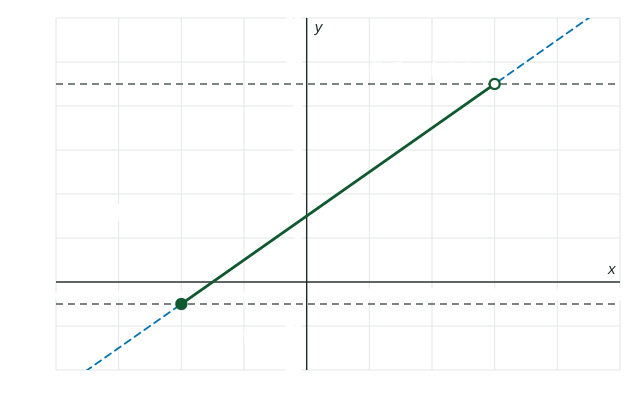
Worked example 2. Which inputs of give outputs with ?
Subtract from all parts: . Divide all parts by : . The answer is .
Domains as intervals
The domain rules from the last topic produce inequalities, so domains come out as intervals. For , the inside must be at least : , so and (flip). The domain is , with a bracket because is fine.
Read the question for inputs or outputs. "Which inputs give outputs at least " wants an interval of -values, not .