
Quadratic functions are the first functions in this course whose rate of change is not constant. Before studying that in Topic 1.3, you need four algebra skills: solving with factors, solving with the quadratic formula, finding the vertex, and completing the square.
Quadratics and parabolas
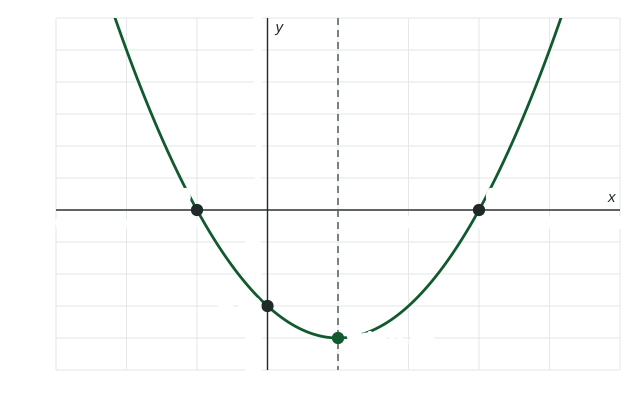
A quadratic function has the form with . Its graph is a parabola: a U shape that opens up when and down when . The turning point is the vertex, and the parabola is symmetric about the vertical line through it, the axis of symmetry.
Solving with factors
If a product is , one of its factors is . So when can be written as a product, each factor gives a solution. For , look for two numbers with product and sum : and . Then , so or .
The equation must equal first. To solve , move everything to one side before you look for factors.
The quadratic formula and the discriminant
Every equation can be solved with the quadratic formula:
Worked example 1. Solve exactly.
, , . Then
. These are exact; does not simplify.
The number under the square root, , is the discriminant. It tells you how many real solutions there are without solving:
| Real solutions | The parabola | |
|---|---|---|
| positive | two | crosses the -axis twice |
| zero | one | touches the -axis at its vertex |
| negative | none | stays on one side of the -axis |
The vertex and completing the square
The vertex of is at . For : , and , so the vertex is .
Completing the square rewrites a quadratic in vertex form , where the vertex can be read off.
Worked example 2. Write in vertex form.
Half of is , and . That has where we need , so subtract :
Vertex form also makes solving easy: gives , so and or . Remember the ; a square root has two signs.
To build a parabola from its vertex and one more point, start with and use the point to find . With vertex and point : , so and .