A system of equations is a set of equations that share unknowns and must all be true at once. In this course you meet systems every time you build a model from data: each data point gives one equation, and the model's constants are the unknowns. This page shows the two hand methods one step at a time, then how to use a calculator without losing accuracy.
What a solution is
A solution makes every equation true. For two lines, it is the point on both lines: where they cross.
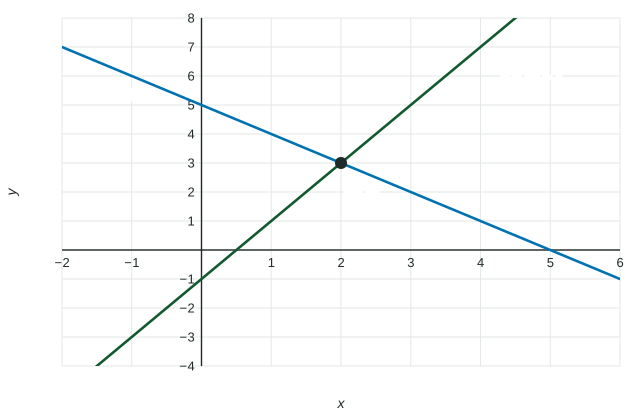
Two lines can also be parallel (same slope, different intercepts), so there is no solution, or be the same line, so every point on it is a solution.
Substitution
Use substitution when one equation already says what a variable equals.
Worked example 1. Solve and .
Replace in the second equation with , in parentheses: .
Distribute: . Combine: . Add : . Divide: .
Back-substitute: . Check in the other equation: . The solution is .
Elimination
Use elimination when adding or subtracting the equations makes a variable cancel. Multiply an equation first if the coefficients do not match.
Worked example 2. Solve and .
The terms are and , so add the equations: , and .
Substitute into the first: , so and .
Three unknowns: a quadratic through three points
To find through three points, substitute each point. The input is squared in the term, so write the powers out.
Worked example 3. Find the quadratic through , and .
: , so .
: , so .
: , so .
Eliminate . Second minus first: . Third minus second: .
Eliminate . Subtract those two: , so .
Work back up: gives ; then gives . The model is . Check : .
With a calculator: store, do not round
Real data give messy decimals, and the calculator part of the exam expects you to use the calculator's system solver. The rule the readers enforce: keep every constant at full precision until the final answer, then give that answer correct to three decimal places. If you round to two places and then use it to find , both and every prediction made with the model can come out wrong in the third decimal place, and lose the point.