Systems of Equations
Solve a system by substitution or elimination, removing one variable at a time.
Part 1 · Hook
Why this matters
Part 2 · Before you start
What this builds on
Part 3 · Prerequisite check
Quick check before you start
1. What is the slope of ?
Show the answer
In , the slope is .
- Correct: :
- :
- :
- :
2. Does the point satisfy ?
- Yes
- No, it gives
- No, it gives
- No, it gives
Show the answer
, so the point is on the graph.
- Correct: Yes:
- No, it gives :
- No, it gives :
- No, it gives :
Part 4 · See it
See it first
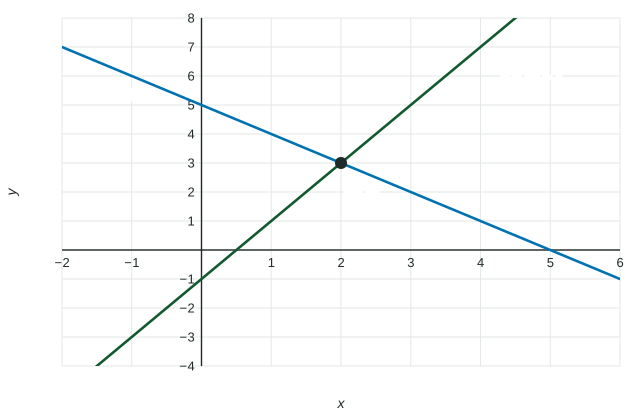
Part 5 · Step by step
How it works, step by step
- Write one equation for each fact (each data point)a system with as many equations as unknowns
- Substitute or add equations to remove one variable at a timeone equation in one variable, which you solve
- Work back up and check every original equationall the unknowns, at full precision
Part 6 · Key ideas
Key ideas
- A solution of a system makes every equation true at once; for two lines it is where they cross.
- To fit to three points, substitute each point to get three equations in , and .
- With a calculator, store each constant; rounding early spoils every value that comes after.
Part 7 · Misconception
A common mistake
The wrong idea: Substituting into gives .
What actually happens: The input is squared for the term: , so .
Part 8 · Check yourself
Check yourself
Exam-style questions. Anything you miss goes into your review queue.
1. Solve the system and by substitution. What is ?
No calculator. Type the exact value (a fraction, π, e or a root is fine).
Show the answer
Substitute : , so , and . Then . Check: .
- Answer: 3
2. Solve and by elimination. What is ?
No calculator. Type the exact value (a fraction, π, e or a root is fine).
Show the answer
Add the equations to eliminate : , so . Substitute: , so and .
- Answer: 2
3. A quadratic passes through , and . Which system gives , and ?
- , ,
- , ,
- , ,
- , ,
Show the answer
Substitute each point into : at , , which is ; the same for the others.
- Correct: , , : Each input is squared for the term.
- , , : The was not squared: , not .
- , , : The inputs and outputs are swapped.
- , , : , not .
4. Solve the system , , . What is ?
No calculator. Type the exact value (a fraction, π, e or a root is fine).
Show the answer
Subtract the first equation from the second: . Subtract the second from the third: . Subtract these: , so . Then and .
- Answer: 1
5. What can you say about the system and ?
- It has one solution, at
- It has many solutions, because the lines are the same
- It has one solution, at
- It has no solution, because the lines are parallel and different
Show the answer
Rewrite the second: , so . Both lines have slope but different -intercepts ( and ), so they never meet.
- It has one solution, at : is on the first line, but .
- It has many solutions, because the lines are the same: The intercepts differ, so the lines are not the same.
- It has one solution, at : gives in the second equation.
- Correct: It has no solution, because the lines are parallel and different: Equal slopes, different intercepts.
Part 9 · Summary
Summary
Part 10 · Up next
What comes next
Part 11 · Connections