Function Model Construction and Application
Build a model from data points (a system), from features and transformations, or by regression; store its constants; use it to predict and to find average rates of change with units, only for inputs the context allows.
Part 1 · Hook
Why this matters
Part 2 · Before you start
What this builds on
Part 3 · Prerequisite check
Quick check before you start
1. Which system gives through , and ?
- , ,
- , ,
- , ,
- , ,
Show the answer
Substitute each point; the input is squared for .
- Correct: , , :
- , , :
- , , :
- , , :
2. What are the domain restrictions a model of a tossed ball's height needs?
- From the toss until the ball lands
- All real times
- Only the times in the data
- Until the ball reaches its highest point
Show the answer
Time starts at the toss, and the model stops describing the ball once it lands.
- Correct: From the toss until the ball lands:
- All real times:
- Only the times in the data:
- Until the ball reaches its highest point:
Part 4 · See it
See it first
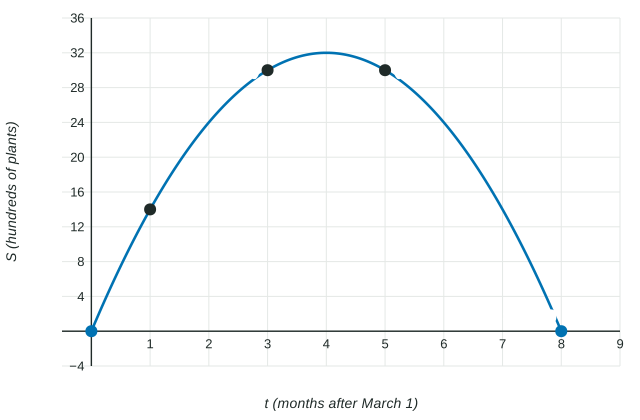
Part 5 · Step by step
How it works, step by step
- Choose the model type from the data and the contexta form with unknown constants, such as
- Substitute data points, or run a regression on the calculatorthe constants, stored at full precision
- Evaluate the model and its average rates of changepredictions with units, inside the domain the context allows
Part 6 · Key ideas
Key ideas
- A model is built from points (a system), from a known feature and transformations (vertex form), or from all the data at once (a regression).
- Inverse proportion: ; inverse-square laws: . One data point gives .
- Report predictions and rates with units: an average rate of change is output units per input unit, such as hundred plants per month.
Part 7 · Misconception
A common mistake
The wrong idea: Once a model fits the data, it can predict any input.
What actually happens: A model is supported only near its data and only where the context allows; past that, its predictions can be impossible, such as negative sales.
Part 8 · Check yourself
Check yourself
Exam-style questions. Anything you miss goes into your review queue.
Table
Monthly sales of a seasonal plant
| (months) | 1 | 3 | 5 |
|---|---|---|---|
| (hundreds of plants) | 14 | 30 | 30 |
1. A quadratic model passes through the three data points. Write and solve the system. What is ?
No calculator. Type the exact value (a fraction, π, e or a root is fine).
Show the answer
The points give , and . Subtracting in pairs: and . Subtracting again: , so ; then and .
- Answer: -2
2. Using the data, what is the average rate of change of on , in hundreds of plants per month?
No calculator. Type the exact value (a fraction, π, e or a root is fine), in hundred plants per month.
Show the answer
- Answer: 8 hundred plants per month
3. For which months does the context allow the model to be used?
- , since sales after would be negative
- , because those are the months in the table
- , because sales start to decrease after
- , because a month number is not negative
Show the answer
is at and and negative after . Sales cannot be negative, so the model can be used for .
- Correct: , since sales after would be negative: The model gives negative sales past .
- , because those are the months in the table: A model can be used between and somewhat beyond its data if the context allows.
- , because sales start to decrease after : Monthly sales can go down; a decrease does not break the context.
- , because a month number is not negative: This misses the upper bound from negative sales.
4. For the light in the previous situation, write as a function of .
Type an expression for .
Show the answer
, and gives . So .
- Answer:
5. A quadratic model has its maximum at and passes through . Write the model using transformations of .
Type an expression for .
Show the answer
Vertex form: . Through : , so and , which equals .
- Answer:
6. A candle is cm tall. After burning for hours it is cm tall. Assuming it burns at a constant rate, what is the rate of change of its height?
No calculator. Type the exact value (a fraction, π, e or a root is fine), then its unit.
Show the answer
cm per hour. The linear model is .
- Answer: -2 cm per hour
Part 9 · Summary
Summary
Part 10 · Up next
What comes next
Part 11 · Connections