Exponent and Radical Rules
Same base: add exponents to multiply, subtract to divide, multiply exponents for a power of a power.
Part 1 · Hook
Why this matters
Part 2 · Prerequisite check
Quick check before you start
1. What is ?
Show the answer
.
- Correct: :
- :
- :
- :
2. Expand .
Show the answer
.
- Correct: :
- :
- :
- :
Part 3 · See it
See it first
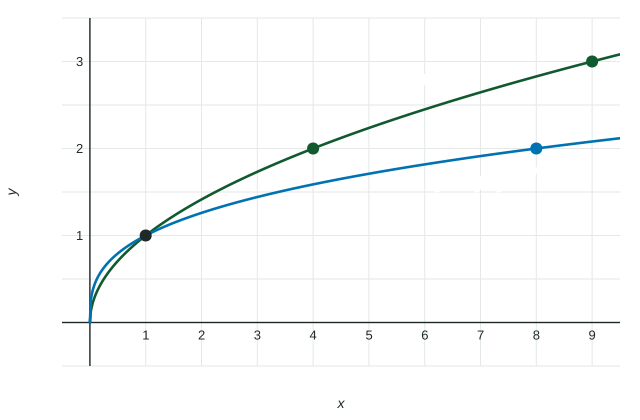
Part 4 · Step by step
How it works, step by step
- Multiply powers of the same baseadd the exponents:
- Raise a power to a powermultiply the exponents:
- Use a negative or fractional exponenttake a reciprocal () or a root ()
Part 5 · Key ideas
Key ideas
- , , , , .
- : a negative exponent is a reciprocal, never a negative number.
- : the denominator is the root, the numerator the power. Take the root first to keep numbers small.
Part 6 · Misconception
A common mistake
The wrong idea: .
What actually happens: . A negative exponent flips the number into a fraction; it does not change the sign.
Part 7 · Check yourself
Check yourself
Exam-style questions. Anything you miss goes into your review queue.
1. Evaluate without a calculator.
No calculator. Type the exact value (a fraction, π, e or a root is fine).
Show the answer
The denominator is a cube root and the numerator is a power:
- Answer: 4
2. Simplify to a single power of .
Type an expression.
Show the answer
Power of a power multiplies: . Same base multiplies by adding exponents:
- Answer:
3. Evaluate exactly.
No calculator. Type the exact value (a fraction, π, e or a root is fine).
Show the answer
- Answer: ≈ 0.250
4. Solve by writing both sides as powers of .
No calculator. Type the exact value (a fraction, π, e or a root is fine).
Show the answer
and . Equal powers of the same base have equal exponents: , so .
- Answer: ≈ 2.500
5. A student writes . What is the error?
- The exponents should be multiplied, giving
- The base stays ; only the exponents are added, giving
- The bases should be added, giving
- There is no error;
Show the answer
When you multiply powers of the same base, keep the base and add the exponents: . The student's is far too large.
- The exponents should be multiplied, giving : Multiplying exponents is for a power of a power, like .
- Correct: The base stays ; only the exponents are added, giving : Keep the base, add the exponents.
- The bases should be added, giving : Bases are never combined by this rule, and exponents are added, not multiplied.
- There is no error; : but .
Part 8 · Summary
Summary
Part 9 · Up next
What comes next
Part 10 · Connections