Unit 2 is built on powers: amounts that double, halve, or grow by a year. Every one of those models is written with exponents, and every Unit 2 manipulation uses the same few rules. This page collects them, with each step shown, so you can use them without a calculator.
The exponent rules
For a positive base and any exponents and :
| Rule | In symbols | Example |
|---|---|---|
| Multiply, same base: add exponents | ||
| Divide, same base: subtract exponents | ||
| Power of a power: multiply exponents | ||
| Power of a product | ||
| Zero exponent | ||
| Negative exponent: reciprocal | ||
| Rational exponent: root, then power |
The most expensive slip is changing the base. is , never : the base stays the same, and only the exponents combine.
Negative exponents
Why does mean ? Follow the pattern down: , , , . Each step down divides by . One more step gives , then . A negative exponent makes a fraction, not a negative number.
Rational exponents and radicals
The exponent is an th root, because . So and . In , the denominator is the root and the numerator is the power.
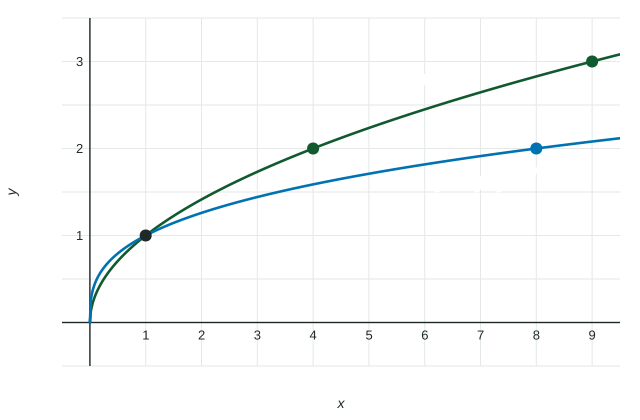
Worked example 1. Evaluate .
Negative exponent first: .
Root before power keeps the numbers small: , because .
Then the power: . So .
Worked example 2. Write as a single power of , for .
The root as a power:
Divide, same base, subtract exponents:
Matching bases to compare exponents
If two powers of the same base are equal, their exponents are equal. That lets you solve some equations with no calculator: rewrite both sides with one base.
Worked example 3. Solve .
Both are powers of : and .
So , which is .
Equal powers of have equal exponents: , so . Check:
In Unit 2 the same moves rewrite a model: , and