Unit 2 begins with lists of numbers in order. A loyalty card that adds stamps per visit and a video whose shares triple every hour both make lists, but one adds the same amount each time and the other multiplies by the same amount. That one difference, adding versus multiplying, runs through the whole unit.
Sequences are functions
A sequence is an ordered list of numbers, called terms. The position is the input and the term is the output, so a sequence is a function whose inputs are whole numbers. We write the terms (or start at ; the problem will say). Because there is no term at position , the graph of a sequence is a set of separate dots, not a connected curve.
Arithmetic sequences: add the same amount
In an arithmetic sequence, each term is the previous term plus a fixed number , the common difference. Starting from , after steps you have added exactly times:
If you know some other term , count the steps from it: . The terms change by equal amounts, so the dots lie on a line with slope .
Worked example 1. An arithmetic sequence has and . Find and a formula for .
From to is steps, and the terms rise by .
Each step adds the same amount, so .
From the known term: . Check: .
Geometric sequences: multiply by the same amount
In a geometric sequence, each term is the previous term times a fixed number , the common ratio. After steps from you have multiplied by exactly times:
From a known term : . To find , divide a term by the one before it.
Worked example 2. A geometric sequence has and . Find and .
From to is steps, so .
Substitute: . Divide by : . Take the cube root: .
So . Check: .
Watch the exponent. If the first term is , then , because getting from position to position takes steps. Writing is the most common slip.
Equal changes versus growing changes
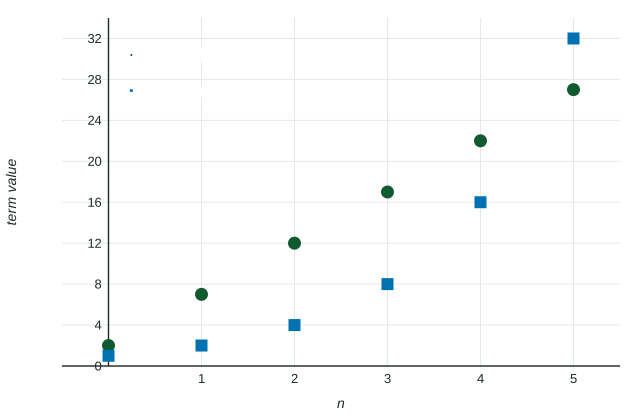
Look at the changes from one term to the next in the figure:
| change in | ||||||
| change in |
An arithmetic sequence changes by equal amounts. An increasing geometric sequence changes by increasing amounts, and the changes themselves are multiplied by each step. That is why the geometric sequence, though it starts lower, passes the arithmetic one at and then pulls away. With the terms shrink instead, by smaller and smaller amounts, as in .
Next topic, the same two patterns get real-number inputs: arithmetic sequences become linear functions, and geometric sequences become the functions of the rest of this unit.