Arithmetic and geometric sequences are defined only at whole-number positions. Fill in every real input between them and you get two of the most useful function types in the course: linear functions, which extend arithmetic sequences, and exponential functions, which extend geometric ones. This page is about telling them apart from a table, and about justifying your answer the way the exam scores it.
Adding versus multiplying
A linear function adds the same amount for each unit of input. An exponential function (with , and ) multiplies by the same factor for each unit of input. If the function shows exponential growth; if , exponential decay.
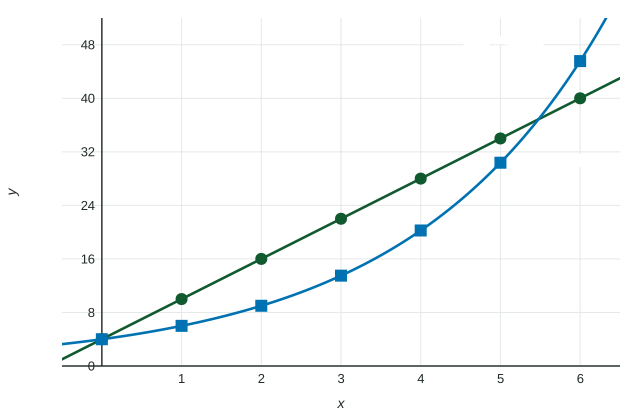
In the figure, the line is ahead at first, but the exponential function's steps keep getting bigger (, , , , ...) and it passes the line between and . An increasing exponential function eventually passes any increasing linear function.
The test, with both halves
Over equal-length input intervals:
| What the outputs do | Function type | Example over steps of |
|---|---|---|
| Change by a constant difference | Linear | : add each time |
| Change by a constant ratio (not or ); the outputs are proportional | Exponential | : multiply by each time |
A full justification names both halves and uses the numbers: "The input intervals all have length , and the outputs over them have a constant ratio,
Worked example 1. A culture has , , , and thousand bacteria at hours. Choose a model and write it.
Equal intervals: each step is hours. Differences: , not constant, so not linear. Ratios: , constant, so exponential.
The output triples every hours, so after hours it has tripled times: .
At , half of a tripling period: . The output is multiplied by each hour, because . Halfway in time is not halfway in value.
The trap: unequal input steps
If the inputs are , the steps are , and , and raw differences or ratios mean nothing until you account for the step lengths.
Worked example 2. is and is at . What could each be?
For , the differences are . Divide each by its step: . A constant rate of change: fits.
For , the ratios are , which look unequal. But over unit, over units, over units: the output doubles for every unit. fits.
An exponential function through a known point
If you know one point and the ratio per unit of input, count the steps from that point, just as for a geometric sequence: . With and a ratio of : , so and .
Rates of change
For a linear function the average rate of change is the same on every interval. For an exponential function, the average rates of change over equal-length intervals have the same ratio as the outputs. In the bacteria table, the average rates on , and are , and thousand per hour: each is times the one before, so the rate of change of is increasing and the graph is concave up.