Change in Linear and Exponential Functions
Over equal-length input intervals, a linear function adds a constant difference and an exponential function multiplies by a constant ratio.
Part 1 · Hook
Why this matters
Part 2 · Before you start
What this builds on
Part 3 · Prerequisite check
Quick check before you start
1. What is the common ratio of the geometric sequence ?
Show the answer
.
- Correct: :
- :
- :
- :
2. What is the average rate of change of on if and ?
Show the answer
.
- Correct: :
- :
- :
- :
Part 4 · See it
See it first
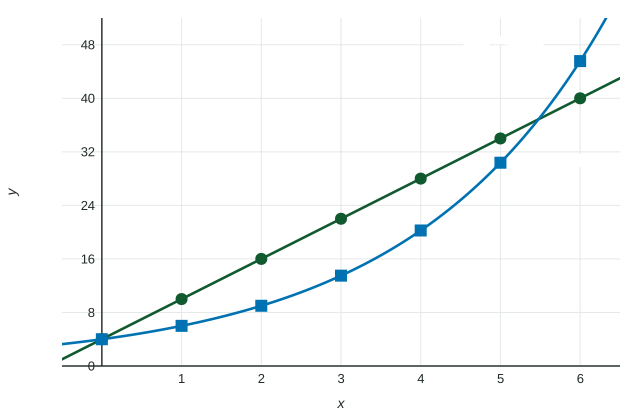
Part 5 · Step by step
How it works, step by step
- Check that the input intervals have equal lengthonly then compare the outputs directly
- Equal differences over the equal intervalsa linear function,
- Equal ratios (not or ) over the equal intervalsan exponential function, , or through a known point
Part 6 · Key ideas
Key ideas
- Linear functions extend arithmetic sequences to all real inputs; exponential functions extend geometric sequences.
- Linear: over equal-length input intervals, the outputs change by equal amounts. Exponential: over equal-length input intervals, the outputs change by equal factors (they are proportional).
- An increasing exponential function eventually passes any increasing linear function.
Part 7 · Misconception
A common mistake
The wrong idea: The outputs increase faster and faster, so the function is exponential.
What actually happens: Say both halves with numbers: the input intervals have equal length, and the outputs over them have a constant ratio. Faster and faster growth also fits a quadratic.
Part 8 · Check yourself
Check yourself
Exam-style questions. Anything you miss goes into your review queue.
Table
Bacteria in a culture
| (hours) | 0 | 2 | 4 | 6 | 8 |
|---|---|---|---|---|---|
| (thousands) | 5 | 15 | 45 | 135 | 405 |
1. Which statement correctly justifies the type of function that fits the table?
- Exponential: the outputs increase faster and faster as increases, so the growth speeds up
- Exponential: over equal input intervals of hours, each output is times the one before
- Linear: over equal input intervals of hours, the outputs increase by a larger amount each time
- Exponential: each output in the table is times the output in the column before it
Show the answer
Both halves are needed: the input intervals have equal length ( hours each), and the outputs over them have a constant ratio (
- Exponential: the outputs increase faster and faster as increases, so the growth speeds up: Faster and faster growth fits many functions (a quadratic too); it is not a justification.
- Correct: Exponential: over equal input intervals of hours, each output is times the one before: Equal-length input intervals and a constant ratio: both halves, with the numbers.
- Linear: over equal input intervals of hours, the outputs increase by a larger amount each time: A linear function needs equal differences, and these are .
- Exponential: each output in the table is times the output in the column before it: This leaves out that the input intervals are equal in length, half of the justification.
2. Write an expression for , in thousands, that fits the table.
Type an expression for .
Show the answer
The outputs triple every hours starting from , so after hours there have been triplings: . Check: .
- Answer:
3. If the pattern in the table continues, what is , in thousands?
No calculator. Type the exact value (a fraction, π, e or a root is fine).
Show the answer
Two more hours is one more tripling: thousand.
- Answer: 1215
Table
Two functions at unequally spaced inputs
| 0 | 1 | 3 | 6 | |
|---|---|---|---|---|
| 10 | 13 | 19 | 28 | |
| 4 | 8 | 32 | 256 |
4. The differences in are , and . Which conclusion is correct?
- is not linear, because the differences , , are not constant
- is exponential, because its differences increase from step to step
- can be linear: each difference divided by its input step is
- is linear, because its outputs increase as increases
Show the answer
The input steps are , and , not equal, so raw differences cannot be compared. Divide each by its step: . A constant rate of change of fits .
- is not linear, because the differences , , are not constant: Constant differences are the test only over equal-length input intervals.
- is exponential, because its differences increase from step to step: The differences grow because the steps grow; the rate is constant.
- Correct: can be linear: each difference divided by its input step is : Unequal steps: compare rates, not raw differences.
- is linear, because its outputs increase as increases: Increasing outputs do not decide the type.
5. Which statement about is supported by the table?
- is not exponential, because the ratios , , are not equal
- is linear, because each ratio of outputs is a whole number
- is exponential with a ratio of for each unit increase in
- can be exponential: outputs double per -unit increase
Show the answer
Over steps of , and units the ratios are , and . That is a doubling for every unit, so fits.
- is not exponential, because the ratios , , are not equal: The ratios differ only because the steps differ.
- is linear, because each ratio of outputs is a whole number: Whole-number ratios do not make a function linear.
- is exponential with a ratio of for each unit increase in : is the ratio over the -unit step.
- Correct: can be exponential: outputs double per -unit increase: Ratio over a step of units: doubling per unit.
6. An exponential function has , and its outputs triple for each increase of in . Write using the point .
Type an expression for .
Show the answer
From a known point with ratio per unit:
- Answer:
Part 9 · Summary
Summary
Part 10 · Up next
What comes next
Part 11 · Connections