Exponential Functions
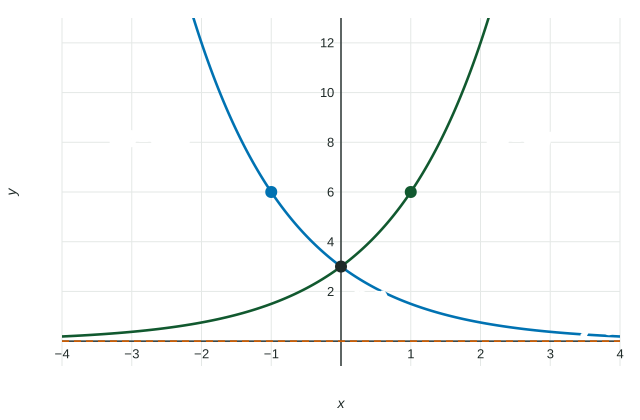
f(x) = ab^x is monotonic with one concavity and a horizontal asymptote, written in limit notation.
Part 1 · Hook
Why this matters
Part 2 · Before you start
What this builds on
Part 3 · Prerequisite check
Quick check before you start
1. Over equal steps, outputs go . What kind of function fits?
- Exponential, ratio
- Linear, slope
- Quadratic
- Linear, slope
Show the answer
Equal steps, constant ratio .
- Correct: Exponential, ratio :
- Linear, slope :
- Quadratic:
- Linear, slope :
2. What does mean?
- As grows without bound, approaches
- is never
- for large
Show the answer
Limit notation describes the value the outputs approach.
- Correct: As grows without bound, approaches :
- :
- is never :
- for large :
Part 4 · See it
See it first
Part 5 · Step by step
How it works, step by step
- (growth) or (decay), with the function is increasing or decreasing everywhere, and concave up
- the graph is reflected across the -axis: concave down
- The output is multiplied by foreverone side approaches the asymptote: for decay, for growth
- Add : the asymptote moves to
Part 6 · Key ideas
Key ideas
- (, , ) is always increasing or always decreasing, has one concavity, and has no extrema or points of inflection.
- Its graph has a horizontal asymptote; write the end behavior in limit notation, such as
. - The base is the growth factor: a increase is ; a decrease is . The natural base is a base used in many models.
Part 7 · Misconception
A common mistake
The wrong idea: approaches as .
What actually happens: The shifts the asymptote: . Find the limit of the exponential part, then add the shift.
Part 8 · Check yourself
Check yourself
Exam-style questions. Anything you miss goes into your review queue.
Graph
The graph of
1. Which statement describes the end behavior of as increases without bound?
Show the answer
As grows, shrinks toward , so approaches : . The line is a horizontal asymptote.
- : This is the limit of alone; the shifts the asymptote up.
- Correct: : The term goes to and remains.
- : The graph falls as increases; it does not grow.
- : This describes the input approaching , which is not end behavior.
2. Which statement describes as decreases without bound?
Show the answer
For negative , grows without bound: . So .
- : The asymptote is on the right side, as .
- : The outputs are all above , so they cannot go to .
- Correct: : Going left, the outputs grow without bound.
- : This is about the right side, and the outputs there approach .
3. Which statement about on the interval is true?
- is decreasing, and the rate of change of is increasing
- is decreasing, and the rate of change of is decreasing
- is increasing, and the graph is concave up
- is decreasing until , then increasing
Show the answer
The outputs fall as increases, so is decreasing. The graph is concave up: the average rates of change over equal intervals are negative but closer to each time ( drops , then , then from to ), so the rate of change of is increasing.
- Correct: is decreasing, and the rate of change of is increasing: Falling, and falling less steeply: rates increasing toward .
- is decreasing, and the rate of change of is decreasing: Rates like are increasing, which means concave up.
- is increasing, and the graph is concave up: The base makes decrease.
- is decreasing until , then increasing: An exponential function has no turning point.
Table
Values of a function
| 0 | 1 | 2 | 3 | |
|---|---|---|---|---|
| 7 | 11 | 19 | 35 |
4. The outputs do not have a constant ratio. Which statement shows that is still an exponential function shifted vertically?
- The differences between outputs show that is linear
- The outputs increase faster and faster, so is exponential
- The values are : they double each step
- The ratio of the last output to the first, , is constant
Show the answer
Subtract from every output: . Over equal steps these have a constant ratio of , so and , an exponential function shifted up .
- The differences between outputs show that is linear: Linear needs constant differences; these double.
- The outputs increase faster and faster, so is exponential: Increasing outputs fit many functions.
- Correct: The values are : they double each step: Shifted outputs that are proportional.
- The ratio of the last output to the first, , is constant: One ratio across the table does not show a pattern over equal steps.
5. A car loses of its value each year. Which model gives its value after years, if it cost ?
Show the answer
Losing leaves , so the decay factor is : .
- : This keeps only each year.
- : This grows by .
- : This subtracts dollars a year.
- Correct: : Keep each year.
6. Why does an exponential function have no local maximum or minimum?
- Its outputs are all positive, so the graph stays above the -axis
- Its graph has a horizontal asymptote that it never reaches
- It is concave up, so the graph bends the same way everywhere
- Each unit step multiplies the output by , so it moves one way only
Show the answer
Over every unit step the output is multiplied by . If every step moves the output away from in the same direction; if , every step moves it toward . The function is increasing everywhere or decreasing everywhere, so it never turns.
- Its outputs are all positive, so the graph stays above the -axis: If the outputs are negative, and there is still no extremum.
- Its graph has a horizontal asymptote that it never reaches: Many functions with asymptotes have extrema.
- It is concave up, so the graph bends the same way everywhere: Concave-up functions such as can have a minimum.
- Correct: Each unit step multiplies the output by , so it moves one way only: One fixed factor, one direction.
Part 9 · Summary
Summary
Part 10 · Up next
What comes next
Part 11 · Connections