Exponential Function Manipulation
Exponent rules rewrite exponential functions: b^(x + k) = b^kb^x (a horizontal shift is a vertical dilation), b^cx = (b^c)^x (a horizontal dilation is a new base) and b^(−x) = (1/b)^x .
Part 1 · Hook
Why this matters
Part 2 · Before you start
What this builds on
Part 3 · Prerequisite check
Quick check before you start
1. Simplify .
Show the answer
Same base: add the exponents.
- Correct: :
- :
- :
- :
2. The graph of is the graph of moved how?
- units left
- units right
- units up
- units down
Show the answer
: the graph moves left.
- Correct: units left:
- units right:
- units up:
- units down:
Part 4 · See it
See it first
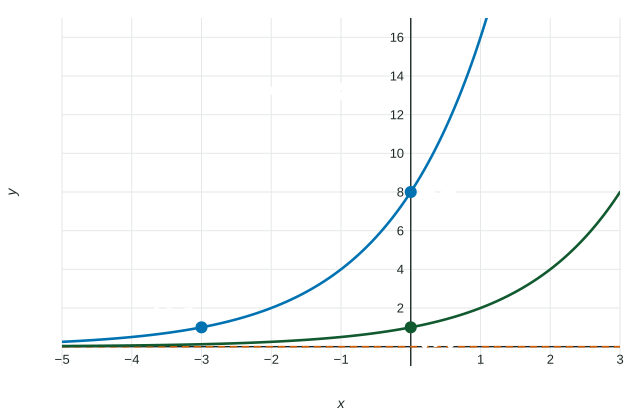
Part 5 · Step by step
How it works, step by step
- Add to the input: by the product rule, : a horizontal translation is a vertical dilation by
- Multiply the input: by the power rule, : a horizontal dilation is a change of base
- Negate the input: : growth reflected across the -axis is decay
Part 6 · Key ideas
Key ideas
- : for an exponential function, shifting the graph horizontally is the same as stretching it vertically.
- and : a horizontal dilation is the same as changing the base.
- Use the rules on whole exponents:
, never .
Part 7 · Misconception
A common mistake
The wrong idea: .
What actually happens: Adding exponents goes with multiplying powers:
Part 8 · Check yourself
Check yourself
Exam-style questions. Anything you miss goes into your review queue.
Graph
The graphs of and
1. Rewrite in the form .
Type an expression for .
Show the answer
Product rule backward:
- Answer:
2. The graph of is the graph of shifted units left. Which other transformation of gives the same graph?
- A vertical shift up
- A vertical dilation by a factor of
- A vertical dilation by a factor of
- A horizontal dilation by a factor of
Show the answer
, so every output of is multiplied by . For an exponential function, a horizontal translation is the same as a vertical dilation.
- A vertical shift up : has asymptote ; keeps .
- A vertical dilation by a factor of : The factor is , not .
- Correct: A vertical dilation by a factor of : Shift left = multiply outputs by .
- A horizontal dilation by a factor of : A horizontal dilation would change the base, not multiply the outputs.
Table
Values of an exponential function
| 0 | 1 | 2 | 3 | |
|---|---|---|---|---|
| 5 | 20 | 80 | 320 |
3. The table fits . Rewrite with base , in the form .
Type an expression for .
Show the answer
, so and . A horizontal dilation of by a factor of gives the same graph as changing the base to .
- Answer:
4. Rewrite as a power of .
Type an expression.
Show the answer
, so
- Answer:
5. Write as a single power of .
Type an expression.
Show the answer
- Answer:
6. A student writes . Which check shows the error?
- At : both sides equal , so the forms agree
- At : and , so the forms agree
- At : and
- At : , but
Show the answer
One input with different values is enough to show two forms are not equivalent. The correct rule is
- At : both sides equal , so the forms agree: , not ; the forms differ at too.
- At : and , so the forms agree: , not .
- At : and : , not ; a check needs correct values.
- Correct: At : , but : , so the forms are not equivalent.
Part 9 · Summary
Summary
Part 10 · Up next
What comes next
Part 11 · Connections