Exponential Function Context and Data Modeling
Build ab^t from an initial value and a ratio, from two points, or by exponential regression.
Part 1 · Hook
Why this matters
Part 2 · Before you start
What this builds on
Part 3 · Prerequisite check
Quick check before you start
1. A quantity decreases by each year. What is the decay factor?
Show the answer
.
- Correct: :
- :
- :
- :
2. Rewrite using a monthly factor, with in years.
Show the answer
by the power rule.
- Correct: :
- :
- :
- :
Part 4 · See it
See it first
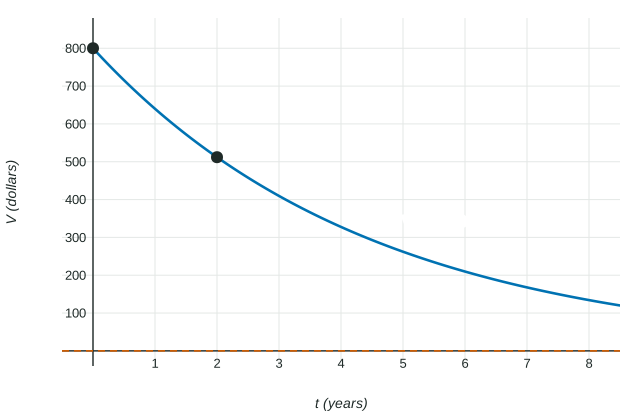
Part 5 · Step by step
How it works, step by step
- Know the initial value and the ratio, or two points, or many data pointsfind and directly, by the ratio over the gap, or by exponential regression
- Read the base as a growth factorpercent change per unit; a -unit factor , a -unit factor
- Use the stored modelpredict an output, or find the input for a given output with the calculator, inside the domain the context allows
Part 6 · Key ideas
Key ideas
- Two points and : , so .
- Exponential regression on the calculator fits to all the data; store and .
- Other time units: a yearly factor is a monthly factor ; a half-life gives .
Part 7 · Misconception
A common mistake
The wrong idea: A weekly growth is per day, a daily factor of .
What actually happens: Growth compounds: the daily factor satisfies , so .
Part 8 · Check yourself
Check yourself
Exam-style questions. Anything you miss goes into your review queue.
Table
Members of a climbing gym
| (years) | 0 | 2 |
|---|---|---|
| (members) | 1200 | 1728 |
1. An exponential model fits the two data points. Write .
Type an expression for .
Show the answer
. Over years the ratio is , so and . .
- Answer:
2. By what percent does the membership grow each year, according to the model?
No calculator. Type the exact value (a fraction, π, e or a root is fine), in percent.
Show the answer
, so the membership grows per year.
- Answer: 20 percent
3. Which expression gives the monthly growth factor of the membership?
Show the answer
A year is months, so and the monthly factor is . Then
- Correct: : Twelve equal monthly factors multiply to .
- : Dividing the factor by gives , a loss.
- : This is the factor over years.
- : Splitting the percent evenly ignores that each month builds on the last; .
4. An exponential function passes through and . Write .
Type an expression for .
Show the answer
From to the output is multiplied by over steps, so and . Then gives .
- Answer:
5. A sample with a half-life of years has grams now. How many grams remain after years?
No calculator. Type the exact value (a fraction, π, e or a root is fine), in grams.
Show the answer
years is half-lives: grams.
- Answer: 10 grams
6. The model gives a city's average home price, in hundreds of thousands of dollars, years after 2020. What does mean?
- The price increases by each year
- The price in 2020 was hundred thousand dollars
- Each year the price rises over the year before
- The price increases by each year
Show the answer
is the growth factor: each year the output is multiplied by , a increase.
- The price increases by each year: The factor multiplies; it is not an added amount.
- The price in 2020 was hundred thousand dollars: The 2020 price is , about .
- Correct: Each year the price rises over the year before: Growth factor .
- The price increases by each year: A increase would more than double the price.
Part 9 · Summary
Summary
Part 10 · Up next
What comes next
Part 11 · Connections