The same exponential function can wear many outfits. , and are one function. and are one function. The exponent rules from "Algebra you need" turn one form into another, and each form has a graphical meaning. This page shows both, because the exam asks you to rewrite exponential expressions exactly and to explain what the rewriting says about the graph.
The rules you use
| Rule | Rewrite | What it says about the graph |
|---|---|---|
| Product: | A horizontal translation is a vertical dilation by | |
| Power: | A horizontal dilation is a change of base | |
| Negative: | Reflecting growth across the -axis gives decay | |
| Rational: | A horizontal stretch by takes the th root of the base |
A horizontal shift is a vertical stretch
For most functions, moving the graph sideways and stretching it upward are different things. For an exponential function they are the same.
Worked example 1. Show that is a vertical dilation of .
The exponent is a sum, so use the product rule backward: .
, so . Every output of is multiplied by .
Check one point: and .
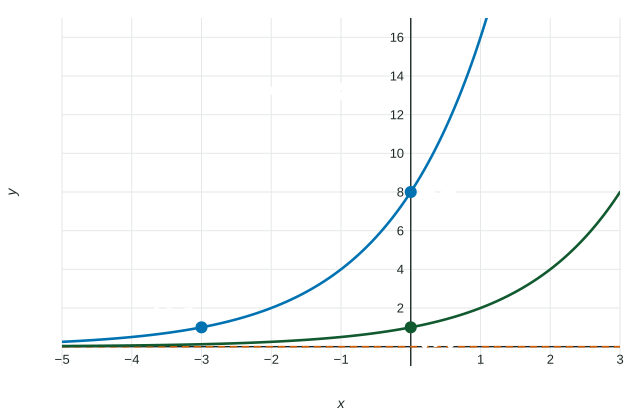
In the figure, the point on moves to under the shift, and the point also lines up with under the stretch. Shifting right instead divides: .
The trap is reading as . Adding in the exponent means multiplying the powers. Test it: at , but .
A horizontal dilation is a new base
Worked example 2. Rewrite with base , and with a single base.
, so . Then : the graph of compressed horizontally by a factor of .
: compressing by a factor of gives base .
It works with fractions too.
Rewriting with every step shown
Rewrite each base as a power of a common base, apply the power rule to the whole exponent, then combine.
Worked example 3. Write as a single power of .
Common base: .
Power rule on the whole exponent:
Divide, same base, subtract exponents:
These rewrites also let you use a known value. If , then , and .
On the exam, a "single power" answer means one base raised to one exponent, with no sums or quotients left over. Stopping at is not finished.