Once you know the graph of one function well, you know a whole family. Shift it, stretch it, flip it, and you get new functions whose graphs you can draw without plotting a single point. The original is the parent; the new one is its transformation, written in terms of the parent, such as .
Outside changes act on outputs
Anything done to after the function has acted changes the outputs, so it moves the graph up or down or stretches it vertically. The inputs stay where they were.
- Vertical translation: moves every point units up (down if ).
- Vertical dilation: multiplies every output by . If the graph is stretched away from the -axis; if it is compressed toward it.
- Reflection across the -axis: changes the sign of every output. A negative dilates and reflects at once.
Inside changes act on inputs, in reverse
Anything done to before the function acts changes which input produces each output. That is why the direction feels backward.
- Horizontal translation: moves the graph units right. Check with a value: , so the output had at now appears at .
- Horizontal dilation: multiplies every input by . So is squeezed toward the -axis by a factor of , and is stretched by a factor of .
- Reflection across the -axis: changes the sign of every input.
| Formula | Acts on | The point on moves to |
|---|---|---|
| outputs | ||
| outputs | ||
| outputs | ||
| inputs | ||
| inputs | ||
| inputs |
Combining transformations
For , work from the input outward: shift the input, apply , multiply by , add . The order matters on the output side. Multiplying by and then adding is not the same as adding and then multiplying by .
Worked example 1. Let and . Where does the point on go, and what is the vertex of ?
The input moves right: . The output is doubled, then lowered by : . So goes to .
Check with the formula:
The vertex goes to
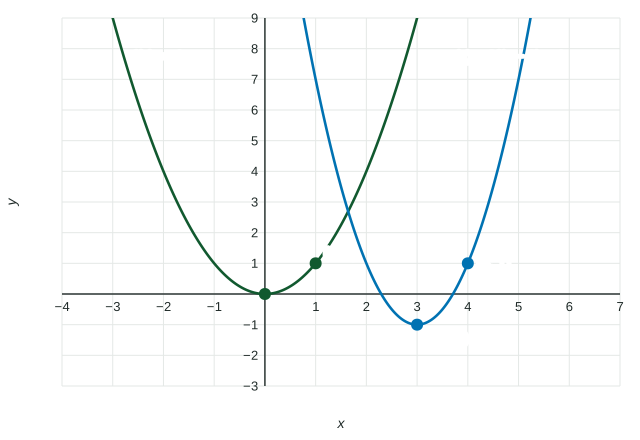
In the figure, looks narrower. That is the vertical stretch: each output, measured from the vertex level, is twice as large.
Writing the new formula
To write as an expression in , replace every in with what is inside the parentheses. Missing one is the most common slip.
Worked example 2. Let . Write in terms of .
Replace each with , in parentheses:
Add :
Expand if you want standard form:
How the domain and range change
Because inside changes act on inputs, they change the domain. Because outside changes act on outputs, they change the range.
Worked example 3. has domain and range . Find the domain and range of .
Domain: needs in , so . The domain is .
Range: multiply the ends by : and . Reorder from least to greatest: .
Tables work the same way. If and the table gives , then . To find where , solve .