Topic 1.4 found where polynomial functions turn and bend. This topic is about where they are zero: how many zeros there are, how the graph behaves at each one, and what happens when some zeros are not real numbers. It ends with two kinds of symmetry, even and odd.
Zeros from factors, and multiplicity
If is a factor of a polynomial , then . When the factor appears to the power , and no higher, is a zero of multiplicity . In , has multiplicity and has multiplicity . A zero of multiplicity is also called a double zero.
Multiplicity controls the graph at the zero:
| Multiplicity | Sign of across the zero | Graph |
|---|---|---|
| odd () | changes | crosses the -axis |
| even () | stays the same | touches the axis and turns back |
The reason: near every other factor keeps its sign, and changes sign only when is odd. An even power is never negative.
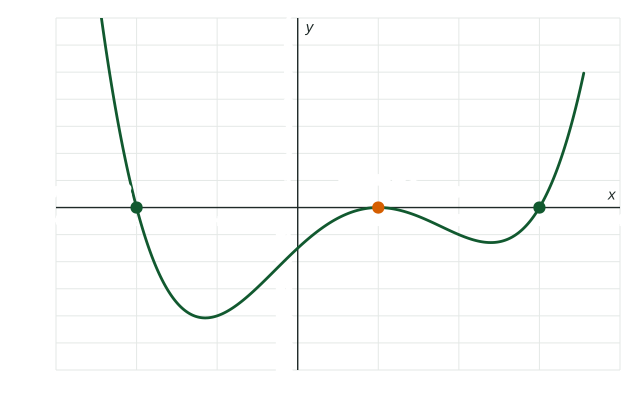
Worked example 1. A degree graph crosses the -axis at and , touches it at , and passes through . Find a formula.
Factors: , and , degree . So
Use the point: , so and
Counting zeros: real and non-real
A polynomial of degree has exactly complex zeros, counting multiplicity. Some may be real (and show as -intercepts); the rest are non-real numbers . When every coefficient is real, the non-real zeros come in conjugate pairs: if is a zero, so is .
Worked example 2. Write the polynomial of least degree, leading coefficient , real coefficients, with zeros and .
Real coefficients force to be a zero as well. Multiply the conjugate factors first:
So
Counting is a good check. A degree polynomial with real coefficients whose zeros include (multiplicity ) and already has : one more zero remains, and it must be real.
Degree from differences
Topic 1.3 showed that a quadratic has constant second differences. The pattern continues: for equally spaced inputs, a polynomial of degree has constant th differences. For at , the outputs have first differences , second differences and third differences : degree .
Even and odd functions
A function is even if for every in its domain. Its graph is symmetric about the -axis: , . A function is odd if . Its graph is symmetric about the origin: , . Most functions are neither; is not odd, because , not .
To test, replace with and simplify. If you get the original back, it is even; if you get its negative, it is odd. For an odd function, means .