Topic 1.9 found vertical asymptotes at zeros of the denominator, but not at every zero: when a factor cancels, there is no asymptote. This topic is about what is there instead, a single missing point called a hole in the graph.
When a factor cancels
Factor the numerator and the denominator. If divides the numerator at least as many times as the denominator, it cancels completely from the denominator. The function is still undefined at (its original denominator is there), but near it behaves like the simplified formula, which has a value at . The graph is the simplified graph with one point removed: a hole.
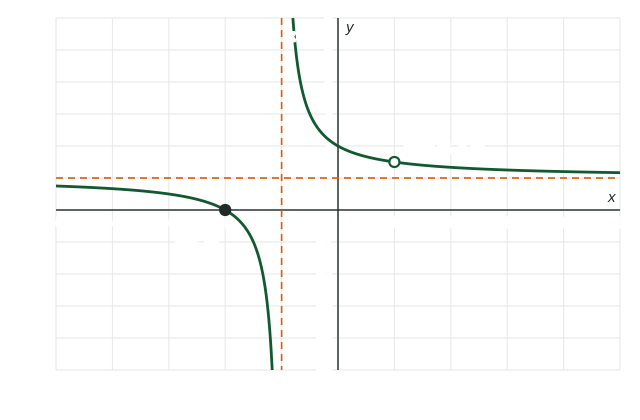
Worked example 1. Analyze
Factor: . So for .
Hole: cancels. Height: . So , and the hole is at .
Vertical asymptote: remains below. , .
Horizontal asymptote: equal degrees, . Zero: (not , which is not in the domain).
Hole or asymptote? Compare multiplicities
| appears | At | Example |
|---|---|---|
| only in the denominator | vertical asymptote | at |
| more times below than above | vertical asymptote | at |
| at least as many times above | hole | at , hole at |
In the last example the hole sits on the -axis, at . It is still not a zero: is not in the domain.
The height of a hole is a limit
A hole at means the outputs approach as approaches from both sides, while does not exist. Write it as . A table shows the same thing: for , the values at , , , are , , , , so .
Contrast this with a vertical asymptote, where the table's values grow without bound in size. Both are inputs outside the domain; the limit tells them apart.
Building a function from its features
The same rules run backward. To make a rational function with a hole at and a vertical asymptote , put the factor both above and below (so it cancels) and leave only below:
Check it: for , , so the hole is at , the vertical asymptote is , and since the denominator has the higher degree the horizontal asymptote is . Swapping the roles of the two factors would swap the features.
Common slips
- Writing for a hole at . The function has no value at ; use .
- Calling zero. It has no value; cancel and evaluate.
- Listing the hole's input as a zero or as a vertical asymptote.