A rational function is zero where its numerator is zero, with one catch: the input has to be in the domain. Its sign can change at its zeros and also at the inputs where it is undefined. Together these facts let you solve inequalities like without a graph, and read them from a graph when you have one.
Zeros of a rational function
A fraction is exactly when its numerator is and its denominator is not. So the real zeros of are the real zeros of that are in the domain of .
Worked example 1. Find the real zeros of
Numerator: , zero at and .
Denominator: , zero at and , so those are excluded.
is excluded, so the only real zero is .
Sign charts
Between consecutive "special" inputs, a rational function keeps one sign. The special inputs are the zeros of the numerator and the zeros of the denominator. At either kind, the sign may change, since a factor in the top or the bottom changes sign there (unless its power is even).
A sign chart records this: mark the special inputs on a number line, pick one test input in each interval, and find the sign there.
| Interval | ||||
|---|---|---|---|---|
| Test input | ||||
| Sign |
Rational inequalities
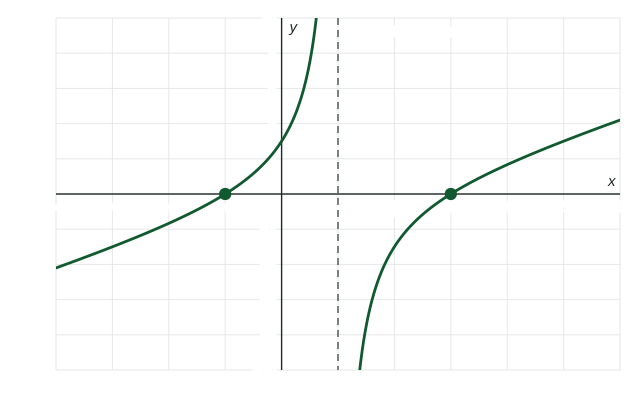
A rational inequality, such as or , is solved by reading the sign chart.
- For or : take the intervals with the right sign, endpoints left out.
- For or : add the zeros, with brackets.
- An excluded input never belongs to the solution: it always gets a parenthesis.
Worked example 2. Solve .
Special inputs: (zero) and (excluded). Test: gives ; gives ; gives .
Solution: . Bracket at the zero , parenthesis at the excluded .
Do not multiply both sides of a rational inequality by a denominator whose sign you do not know; the direction of the inequality depends on it. In context it is often known: for with , the denominator is positive, so becomes , or .
With a calculator
When the numerator does not factor nicely, graph the function and find every zero. For