Rational Functions and Zeros
The real zeros of a rational function are the numerator's zeros that are in its domain.
Part 1 · Hook
Why this matters
Part 2 · Before you start
What this builds on
Part 3 · Prerequisite check
Quick check before you start
1. What is ?
Show the answer
The denominator has the higher degree.
- Correct: :
- :
- :
- :
2. Solve .
Show the answer
, flip: .
- Correct: :
- :
- :
- :
Part 4 · See it
See it first
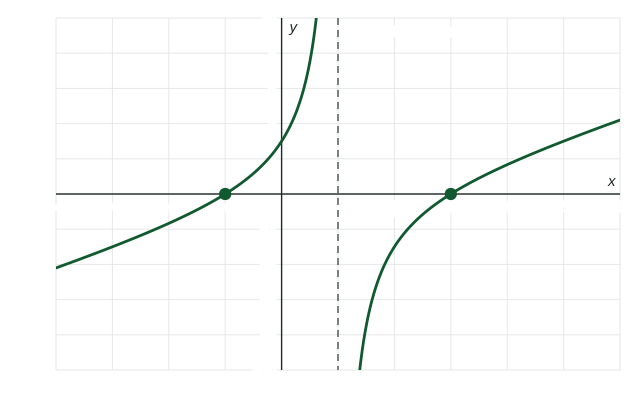
Part 5 · Step by step
How it works, step by step
- The numerator of is at an input in the domainthat input is a real zero of
- The denominator is at an inputthat input is not in the domain, so it is never a zero
- You mark zeros and excluded inputs on a number linethey split it into intervals where keeps one sign: test one input in each
- The inequality is or include the zeros with brackets; excluded inputs always get parentheses
Part 6 · Key ideas
Key ideas
- Real zeros of : the zeros of that are in the domain (not zeros of ).
- A sign chart splits the line at the zeros of both numerator and denominator; one test value per interval gives its sign.
- Solve a rational inequality from the chart; include zeros only for or , never an excluded input.
- With a calculator: graph, find every zero, then read the sign between them.
Part 7 · Misconception
A common mistake
The wrong idea: has zeros and , because there.
What actually happens: At the denominator is , so is not in the domain and not a zero. The only zero is .
Part 8 · Check yourself
Check yourself
Exam-style questions. Anything you miss goes into your review queue.
Table
Test values for a sign chart
| Interval | ||||
|---|---|---|---|---|
| Test input | -4 | -2 | 0 | 3 |
| -2 | 4 | -6 | 1.5 | |
| Sign of |
1. The table uses
- and
- , and
- and
Show the answer
The real zeros of a rational function are the zeros of the numerator that are in its domain: and . The denominator's zero, , is excluded.
- Correct: and : Right: the numerator is there, and both are in the domain.
- , and : At the denominator is : is undefined, not .
- and : The factor is at , and at .
- : is the input not in the domain.
2. The table uses
Show the answer
Read the signs: on and . Strict inequality, so the zeros are left out; is never included because it is not in the domain.
- Correct: : Right: the intervals marked , with the endpoints left out because must be strictly positive.
- : These are the intervals where is negative.
- : At and , , which is not ; and is not in the domain.
- : The interval is positive too: .
3. The table uses
Show the answer
Negative on and ; zero at and (included for ); undefined at (excluded).
- : includes the zeros: .
- : is not in the domain, so it takes a parenthesis.
- Correct: : Right: the negative intervals plus the zeros, without .
- : These are where .
Graph
The graph of
4. Let
Calculator allowed. Give the answer correct to three decimal places.
Show the answer
Graph and use the zero feature near : (the true value is , so truncated is also accepted).
- Answer: 1.861
5. Let
Show the answer
The denominator is always positive, so has the sign of . Its zeros (about , , ) split the line; test and .
- Correct: : Right: the graph is above the axis between the first two zeros and after the third.
- : These are where the graph is below the axis.
- : , so part of the solution is between and .
- : Between and the graph dips below the axis: .
6. What is the real zero of ?
No calculator. Type the exact value (a fraction, π, e or a root is fine).
Show the answer
Set the numerator to : , . It is in the domain ().
- Answer: ≈ 2.500
Part 9 · Summary
Summary
Part 10 · Up next
What comes next
Part 11 · Connections