Rational Functions and Vertical Asymptotes
A rational function has a vertical asymptote x = a where (x − a) divides the denominator more times than the numerator.
Part 1 · Hook
Why this matters
Part 2 · Before you start
What this builds on
Part 3 · Prerequisite check
Quick check before you start
1. Which inputs make undefined?
- and
Show the answer
.
- Correct: and :
- :
- :
- :
2. At a zero of multiplicity , the graph of a polynomial
- touches the axis without crossing
- crosses the axis
- has a break
- is vertical
Show the answer
An even power does not change sign.
- Correct: touches the axis without crossing:
- crosses the axis:
- has a break:
- is vertical:
3. What is ?
Show the answer
Equal degrees: .
- Correct: :
- :
- :
- :
Part 4 · See it
See it first
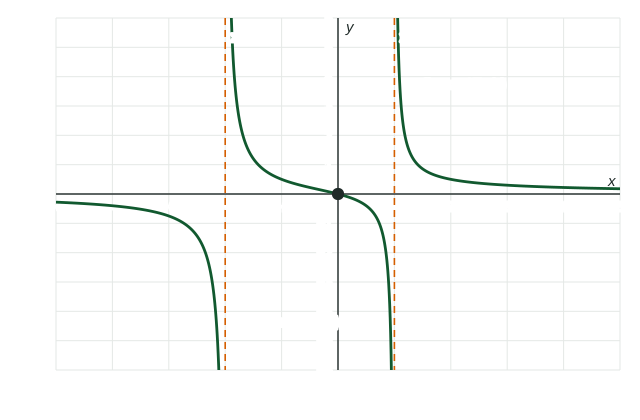
Part 5 · Step by step
How it works, step by step
- is a factor of the denominator, with higher multiplicity than in the numerator is a vertical asymptote: outputs grow without bound in size near
- The factor appears equally often (or more) in the numeratorit cancels and there is no vertical asymptote at
- You test the signs of the factors just left and just right of you get each one-sided limit, or
- The leftover power of is evenboth one-sided limits have the same sign
Part 6 · Key ideas
Key ideas
- Vertical asymptote : the outputs increase or decrease without bound as approaches from one side or both.
- For a rational function: a zero of the denominator with greater multiplicity than in the numerator.
- One-sided limits: from the left, from the right, each or .
- Find the sign with a test input just beside , such as and .
Part 7 · Misconception
A common mistake
The wrong idea: Every zero of the denominator is a vertical asymptote.
What actually happens: Cancel common factors first. has a zero denominator at , but the factor cancels and the outputs approach there. Its only vertical asymptote is .
Part 8 · Check yourself
Check yourself
Exam-style questions. Anything you miss goes into your review queue.
Graph
The graph of
1. What is the vertical asymptote of the graph of ?
Show the answer
makes the denominator while the numerator is . The outputs grow without bound near , so is a vertical asymptote.
- : At the numerator is : that is a zero of , not an asymptote.
- Correct: : Right: the denominator is at and the numerator is not.
- : is the horizontal asymptote.
- : is at ; squaring does not change where.
2. Which pair of statements describes near ?
- and
- and
- and
Show the answer
Near the numerator is near (positive) and is a small positive number on both sides, so is large and positive on both sides.
- Correct: and : Right: both sides rise without bound.
- and : That pattern goes with an odd power in the denominator; here is never negative.
- and : The right side also rises: .
- : is undefined; describe what happens near with one-sided limits.
3. Why does have the same one-sided behavior on both sides of ?
- Because near the numerator is positive and is positive on both sides
- Because is a zero of the numerator, so both sides behave the same way
- Because has a horizontal asymptote, so both ends of the graph behave alike
- Because the graph is symmetric about the vertical line
Show the answer
The sign of near the asymptote comes from the signs of its factors. An even power of stays positive, so both one-sided limits have the sign of the numerator, .
- Correct: Because near the numerator is positive and is positive on both sides: Right: the denominator's factor has an even power, so it does not change sign at .
- Because is a zero of the numerator, so both sides behave the same way: The numerator is at , not .
- Because has a horizontal asymptote, so both ends of the graph behave alike: End behavior says nothing about the outputs near .
- Because the graph is symmetric about the vertical line : It is not: but .
Table
Outputs near
| 0.9 | 0.99 | 0.999 | 1.001 | 1.01 | 1.1 | |
|---|---|---|---|---|---|---|
| -18.10 | -198.01 | -1998.00 | 2002.00 | 202.01 | 22.10 |
4. The table gives values of near . Which describes as approaches from the left?
Show the answer
For just below , the top is near and the bottom is a small negative number, so is a large negative number: .
- : The values to the left of are negative: , , .
- Correct: : Right: the outputs are negative and grow without bound in size.
- : is the numerator's value at , not the limit.
- : The notation means from the right; the question asks about the left.
5. The table gives values of near . Which describes as approaches from the right?
Show the answer
Just right of , is a small positive number and the top is near : .
- Correct: : Right: the outputs , grow without bound.
- : To the right of the bottom is positive, so the outputs are positive.
- : The outputs grow as gets closer to , not shrink.
- : is undefined. Use a one-sided limit.
6. Which vertical asymptotes does
- and
Show the answer
A vertical asymptote sits at a zero of the denominator whose multiplicity is greater than in the numerator. appears once in each, so is not an asymptote; appears only below, so is.
- and : The factor cancels: near the outputs approach instead of growing.
- Correct: : Right: after cancelling, still has a zero denominator at .
- : At the numerator is too, with the same multiplicity, so there is no asymptote there.
- : That is the horizontal asymptote.
Part 9 · Summary
Summary
Part 10 · Up next
What comes next
Part 11 · Connections