End behavior describes a rational function far from the origin. This topic looks at the places where it blows up: inputs where the denominator is and the outputs grow without bound. Those vertical lines are vertical asymptotes, and the way to describe them precisely is with one-sided limits.
Where vertical asymptotes come from
Near an input where the denominator of is but the numerator is not, the outputs are a fixed number divided by a tiny number: they grow without bound in size. The vertical line is then a vertical asymptote.
When the numerator is at too, compare multiplicities. If divides the denominator more times than the numerator, there is still a vertical asymptote at . If not, the factor cancels away and the outputs approach a number instead. The next topic studies that case.
Worked example 1. Find the vertical asymptotes of
Denominator zeros: and . The factor appears once on top and once below, so it cancels: for .
Only is a vertical asymptote.
One-sided limits
A one-sided limit describes the outputs as the input approaches from one side only. means "as approaches from the left" (inputs less than ) and "from the right". At a vertical asymptote each one-sided limit is or .
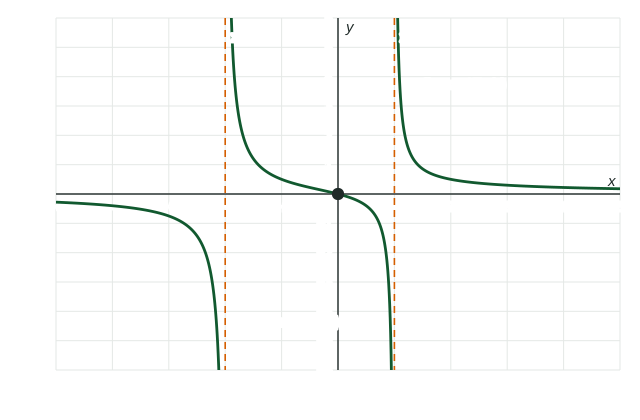
To find the sign, look at each factor just beside .
Worked example 2. Describe
Left of (say ): top ; and small; . The quotient is negative and huge: .
Right of (say ): , everything else the same: .
When the leftover power of is even, it is positive on both sides, so both one-sided limits match. For
| Leftover power of below | Sides of the asymptote | Example near |
|---|---|---|
| odd | opposite signs | : left, right |
| even | same sign | : on both sides |
Writing it for a grader
Write both one-sided limits in full: " and ." These lose the point: "" ( does not exist), " at " (no limit notation, no side), or a limit with the wrong side.
In context, translate both parts: for says that as the volume shrinks toward , the pressure grows without bound.
From a table
A table of inputs closing in on from each side shows the same thing. For : and on the left; and on the right. So and .