
Divide one polynomial by another and you get a rational function. Its ends can do three things: level off at a constant, shrink to , or keep growing, sometimes along a slanted line. This topic predicts which from the leading terms and writes the answer in limit notation.
Rational functions
A rational function has the form , where and are polynomials. Examples: , , average cost .
The quotient of the leading terms
Topic 1.6 showed that for large a polynomial behaves like its leading term. Apply that to the top and bottom separately, and a rational function behaves like the quotient of the two leading terms.
| Degrees | Quotient of leading terms | End behavior | Example |
|---|---|---|---|
| top less than bottom | goes to | horizontal asymptote | |
| equal | a constant | horizontal asymptote | |
| top one more | linear, | slant asymptote | |
| top two or more more | or higher | like a polynomial |
Horizontal asymptotes
If or , the line is a horizontal asymptote: the graph gets as close to it as you like far out.
Worked example 1. Describe the end behavior of
Leading terms: . So and ; the horizontal asymptote is .
Which side? , so , always a little below .
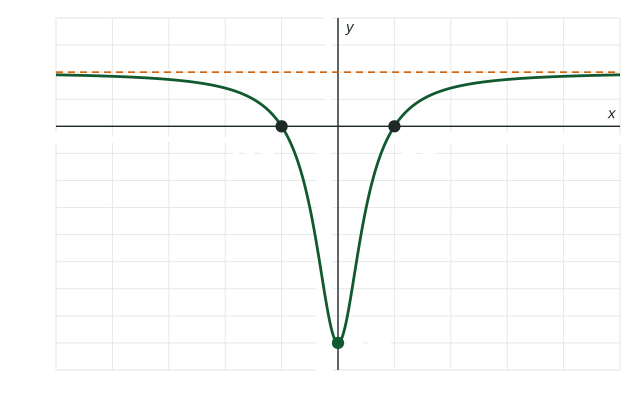
An asymptote describes the ends, not the middle. A graph may cross its horizontal asymptote: is at and still has the asymptote .
Slant asymptotes
When the top's degree is one more than the bottom's, the quotient of the leading terms is linear and the graph approaches a slanted line. To find it, rewrite the function as a line plus a fraction that goes to .
Worked example 2. Find the slant asymptote of
Write the top around the bottom:
So . As , , and the graph approaches .
With a single-term denominator it is quicker:
In context
The poster shop's average cost