So far you have studied polynomial graphs up close: their zeros, turning points and bends. This topic zooms out. Far from the origin, every polynomial graph looks like the graph of its leading term, and its ends either rise or fall without bound. That long-run behavior is the end behavior, and the exam wants it written in limit notation.
Why the leading term wins
Take . At , and : the second term is bigger and . At , and : the leading term has pulled ahead, and it stays ahead for every larger . A higher power always outgrows a lower one eventually.
So the end behavior of any polynomial is the end behavior of its leading term , which depends on only two things: whether is even or odd, and whether is positive or negative.
| even degree | , (both up) | , (both down) |
| odd degree | , (down, up) | , (up, down) |
Limit notation
The statement reads: "as increases without bound, increases without bound." Likewise means that as decreases without bound, decreases without bound. Write all four parts every time: , the function with its input, where the input goes, and where the outputs go.
These lose the point on the exam: "" (no input), "" ( is not an input), and "" (no function).
Finding the leading term
When the polynomial is a product, multiply the leading parts of the factors; you do not need to expand.
Worked example 1. Find the end behavior of .
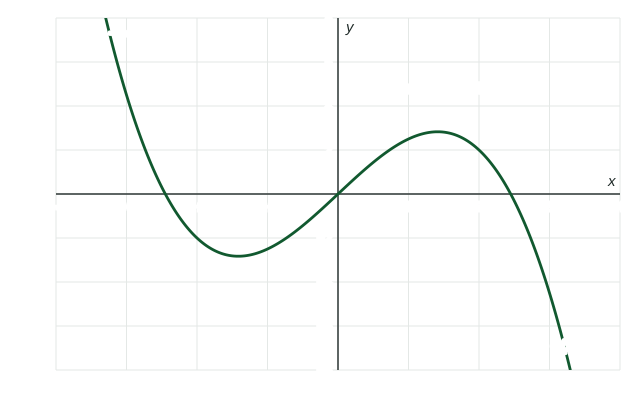
Leading part of is , so of it is . Leading term: .
Odd degree, negative coefficient: and .
Worked example 2. Find the end behavior of
Leading term: . Even degree, negative: and .
Because both ends fall, has a global maximum but no global minimum.
What end behavior tells you
- An odd-degree polynomial has at least one real zero: one of its ends is above the -axis and the other below, and its graph has no breaks, so it must cross.
- An even-degree polynomial has a global maximum (both ends down) or a global minimum (both ends up).
- End behavior says nothing about the middle of the graph. A table of a few large-ish inputs can mislead if the leading term has not taken over yet.