Polynomial Functions and End Behavior
As |x| grows, a polynomial behaves like its leading term a_nx^n .
Part 1 · Hook
Why this matters
Part 2 · Before you start
What this builds on
Part 3 · Prerequisite check
Quick check before you start
1. What is the leading term of ?
Show the answer
The highest power of .
- Correct: :
- :
- :
- :
2. is an even function. Its graph is symmetric about
- the -axis
- the origin
- the -axis
- the line
Show the answer
.
- Correct: the -axis:
- the origin:
- the -axis:
- the line :
Part 4 · See it
See it first
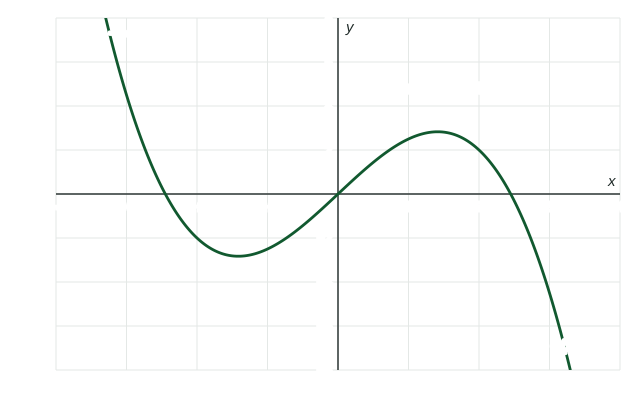
Part 5 · Step by step
How it works, step by step
- grows largethe leading term outgrows every other term
- The degree is evenboth ends go the same way: up if , down if
- The degree is oddthe ends go opposite ways: left down and right up if , the reverse if
- You report end behaviorwrite both limits in full, such as
Part 6 · Key ideas
Key ideas
- End behavior: what the outputs do as and as . For a polynomial, the leading term decides it.
- Limit notation: reads "as increases without bound, increases without bound."
- Even degree: ends match. Odd degree: ends opposite. The sign of the leading coefficient picks which way.
Part 7 · Misconception
A common mistake
The wrong idea: If the first few large inputs give negative outputs, then .
What actually happens: End behavior is decided by the leading term, which may take over late. is negative at and , but because wins once .
Part 8 · Check yourself
Check yourself
Exam-style questions. Anything you miss goes into your review queue.
Graph
The graph of a polynomial function
1. The graph shows
Show the answer
The leading term is : for large , is huge and positive, and makes it huge and negative. So .
- : The right end falls, so the outputs decrease without bound.
- Correct: : Right: as increases without bound, decreases without bound.
- : The graph does not level off at ; it keeps falling.
- : This is about the left end, .
2. The graph shows
Show the answer
is negative for every large , so both ends fall: .
- : For even degree, both ends go the same way; here both fall.
- : is a zero; the graph keeps falling past it.
- Correct: : Right: is positive, times , so the outputs fall without bound.
- : True, but that describes the right end.
3. The graph shows
- Degree , negative
- Degree , positive
- Degree , negative
- Degree , negative
Show the answer
Leading term : even degree (ends match) and negative (both fall).
- Correct: Degree , negative: Right: four factors of , and the leading coefficient is .
- Degree , positive: A positive leading coefficient with even degree would make both ends rise.
- Degree , negative: Odd degree would send the two ends in opposite directions.
- Degree , negative: There are four factors : degree .
Table
Outputs at large inputs
| 10 | 20 | 30 | 50 | 100 | |
|---|---|---|---|---|---|
| -3,000 | -4,000 | 9,000 | 125,000 | 1,500,000 |
4. The table gives values of . Which statement describes the end behavior of as increases?
Show the answer
For large the leading term is far bigger than , so grows without bound: .
- : The first values are negative, but by the outputs grow without bound.
: is one output; the outputs keep growing. - Correct: : Right: the leading term wins for large .
- : is the leading coefficient, not a limit of the outputs.
5. The table gives values of . Why are and negative even though grows without bound?
- is larger in size than until passes .
- The table's values were computed incorrectly from the formula.
- So the end behavior is really .
- Negative outputs mean the leading coefficient is negative.
Show the answer
End behavior is about large inputs. is negative for and positive after, so the leading term takes over only past .
- Correct: is larger in size than until passes .: Right: exactly when ; after that the leading term dominates.
- The table's values were computed incorrectly from the formula.:
is correct. - So the end behavior is really .: The later values grow without bound; the end behavior is about large .
- Negative outputs mean the leading coefficient is negative.: The leading coefficient, , is positive.
6. Which statement about for is written correctly?
Show the answer
Write limit notation in full: . Graders do not accept "" or .
- : It leaves out the input: say , in limit notation.
- Correct: : Right: function, input, where the input goes, and where the outputs go.
- : is not an input; means nothing.
- : Do not mix an arrow into the statement: the limit equals .
Part 9 · Summary
Summary
Part 10 · Up next
What comes next
Part 11 · Connections