The same function can be written in several ways that look nothing alike. , and all give the same output for every input except . They are equivalent forms. You choose the form that answers the question in front of you, the way you would pick the right map for a trip.
Why rewrite at all
Each form puts different features in plain view. The skill on the exam is knowing which form to reach for, and getting to it without an algebra slip.
| Form | Example | What you can read straight off it |
|---|---|---|
| Standard form | The leading term , so the end behavior; the -intercept (the constant term) | |
| Factored form | The zeros , and and their multiplicities; for a rational function, holes, vertical asymptotes and the domain | |
| Quotient plus remainder | The slant or horizontal asymptote (the quotient) and which side of it the graph is on (the sign of the remainder term) |
Factored form: zeros, holes and asymptotes
Once a rational function is factored top and bottom, you can read almost everything. A factor on top gives a zero, as long as that input is in the domain. A factor on the bottom gives a vertical asymptote. A factor that appears on both and cancels gives a hole instead.
Worked example 1. Describe
Factor the top: two numbers with product and sum are and , so
Factor the bottom: product , sum gives and , so
So
The factor cancels, so there is a hole at . What is left, , has a zero at and a vertical asymptote at .
Polynomial long division
Dividing polynomials works like dividing numbers. Dividing by gives : divisor times quotient plus remainder. For polynomials it is the same sentence, and the remainder always has a lower degree than the divisor:
The steps repeat: divide the leading terms, multiply the divisor by that result, subtract, and bring down the next term.
Worked example 2. Write
Divide the leading terms: . Multiply: . Subtract:
Divide again: . Multiply: . Subtract: . The remainder has degree , lower than the divisor, so you stop.
Result:
Check with one input: at , and . They match.
When the divisor is , synthetic division is a shortcut: write the coefficients, use (not ), and put a in for any missing power. A useful fact falls out: the remainder equals , because the divisor is at .
Slant asymptotes from the quotient
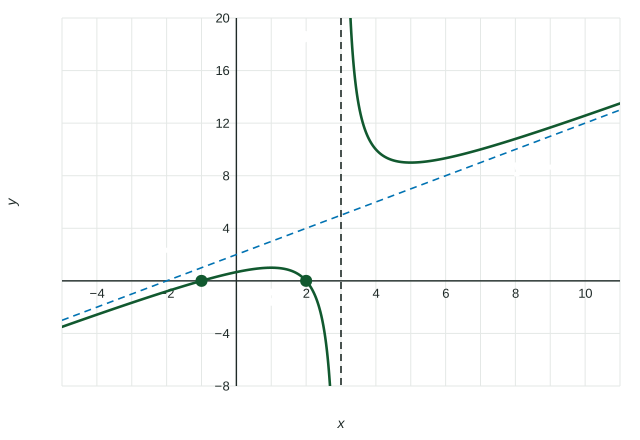
Look at for a very large input, like . The remainder term is , nearly , so is nearly . That is why the line is a slant asymptote (see the figure). It appears when the numerator's degree is one more than the denominator's.
The remainder term also tells you which side of the line the graph is on. For , is positive, so the graph is above the line; for it is negative, so the graph is below.
Expanding powers with Pascal's triangle
Multiplying out by hand takes four rounds of distributing. Pascal's triangle does it at once. Each row starts and ends with , and every other entry is the sum of the two entries above it. Row gives the coefficients of , and the powers of count down while the powers of count up.
Worked example 3. Expand .
Row is . Pair each with and :
The most common slip is forgetting to raise the to its power. The term is , not .
If the second term is negative, as in , the powers of alternate in sign, so the signs of the terms alternate too.