Equivalent Representations of Polynomial and Rational Expressions
Factored form shows zeros, holes, vertical asymptotes and the domain; standard form shows end behavior; division writes a rational function as quotient plus remainder over divisor, and a linear quotient is the slant asymptote.
Part 1 · Hook
Why this matters
Part 2 · Before you start
What this builds on
Part 3 · Prerequisite check
Quick check before you start
1. Factor .
Show the answer
Two numbers with product and sum : and .
- Correct: :
- :
- :
- :
2. Where does
- Nowhere
Show the answer
The factor cancels, so the graph has a hole at ; is a vertical asymptote.
- Correct: :
- :
- :
- Nowhere:
Part 4 · See it
See it first
Part 5 · Step by step
How it works, step by step
- Factor the numerator and the denominatorread zeros, holes, vertical asymptotes and the domain
- Multiply out to standard formread the leading term and so the end behavior
- Divide the numerator by the denominatorget quotient remainder over divisor, and the quotient is the slant or horizontal asymptote
- Use a row of Pascal's triangleexpand without multiplying it out
Part 6 · Key ideas
Key ideas
- Equivalent forms give the same output for every input in the domain; each form makes different features easy to read.
- Polynomial long division writes dividend divisor quotient remainder, so
. - When the quotient is linear, the line is a slant asymptote: the remainder term shrinks toward for large inputs.
- Row of Pascal's triangle gives the coefficients of ; each entry is the sum of the two above it.
Part 7 · Misconception
A common mistake
The wrong idea: The remainder from dividing by can be ignored, so equals the quotient.
What actually happens: The remainder stays as . It is small only for large inputs, which is why the quotient is an asymptote and not the function itself.
Part 8 · Check yourself
Check yourself
Exam-style questions. Anything you miss goes into your review queue.
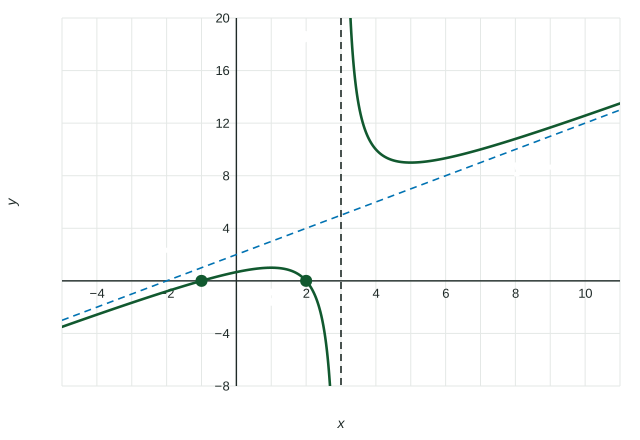
Graph
The graph of
1. The graph shows . Which form of shows its slant asymptote directly?
Show the answer
Long division gives
- : Factored form shows the zeros and and the vertical asymptote, not the slant asymptote.
- Correct: : The quotient is the slant asymptote, and the remainder term fades for large inputs.
- : This is the original quotient; the line it approaches is hidden until you divide.
- : This swaps the divisor and the quotient. Check it: at it gives , but .
2. Divide to find the slant asymptote of
Type an expression for .
Show the answer
Divide by : ; subtract to leave ; ; subtract to leave the remainder . The quotient is , so the slant asymptote is .
- Answer:
3. Using the factored form
Show the answer
A zero of a rational function is a zero of the numerator that is in the domain: and give and , and neither makes the denominator .
- Correct: : at , and the denominator is there.
- Correct: : at , and the denominator is there.
- : makes the denominator : it is the vertical asymptote, not a zero.
- : At the numerator is , not ; this sign slip reads as .
4. Divide by . Write the quotient.
Type an expression for .
Show the answer
Synthetic division with : bring down ; ; ; . The quotient is with remainder , so
- Answer:
5. Which form of shows its zeros and which shows its end behavior?
- shows the zeros; shows the end behavior
- shows the zeros; shows the end behavior
- shows both, and standard form shows neither
- shows the zeros; shows the end behavior
Show the answer
Factor:
- Correct: shows the zeros; shows the end behavior: Each factor gives a zero; the leading term gives the end behavior.
- shows the zeros; shows the end behavior: Standard form hides the zeros; you must factor to see them.
- shows both, and standard form shows neither: Factored form can show end behavior after you multiply the leading parts, but standard form shows it at a glance, so it is not "neither".
- shows the zeros; shows the end behavior: The signs are swapped:
, not .
Table
Pascal's triangle, rows 0 to 6
| Row | Coefficients |
|---|---|
| 0 | 1 |
| 1 | 1 1 |
| 2 | 1 2 1 |
| 3 | 1 3 3 1 |
| 4 | 1 4 6 4 1 |
| 5 | 1 5 10 10 5 1 |
| 6 | 1 6 15 20 15 6 1 |
6. Use the table. What is the coefficient of in the expansion of ?
No calculator. Type the exact value (a fraction, π, e or a root is fine).
Show the answer
Row is . The term is .
- Answer: 54
Part 9 · Summary
Summary
Part 10 · Up next
What comes next
Part 11 · Connections