Transformations of Functions
g(x) = af(b(x − h)) + k dilates and reflects f by a and b and translates it h right and k up.
Part 1 · Hook
Why this matters
Part 2 · Before you start
What this builds on
Part 3 · Prerequisite check
Quick check before you start
1. If , what is ?
Show the answer
Replace every with : .
- Correct: :
- :
- :
- :
2. What is the vertex of ?
Show the answer
Vertex form has vertex ; here and .
- Correct: :
- :
- :
- :
Part 4 · See it
See it first
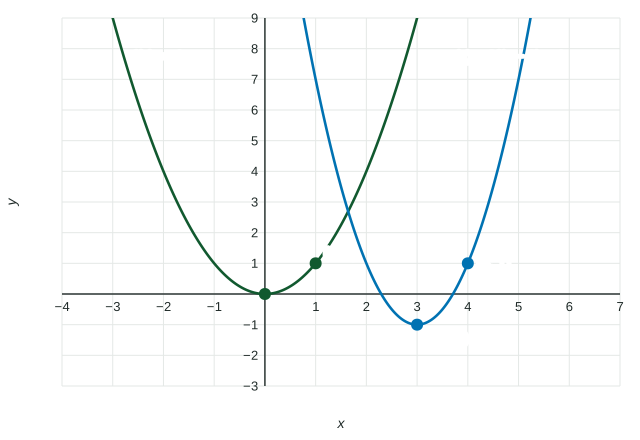
Part 5 · Step by step
How it works, step by step
- Add a constant outside: every output moves by (a vertical translation)
- Add a constant inside: the graph moves units left when (a horizontal translation)
- Multiply outside: outputs are multiplied by (a vertical dilation; reflection across the -axis if )
- Multiply inside: inputs are scaled by (a horizontal dilation; reflection across the -axis if )
Part 6 · Key ideas
Key ideas
- Changes outside the function act on outputs and move the graph up, down, or stretch it vertically. Changes inside act on inputs and work in reverse.
- moves the graph right: the old output at now appears at .
- In , dilate first, then shift. Domain changes come from inside changes; range changes come from outside changes.
Part 7 · Misconception
A common mistake
The wrong idea: moves the graph units right, because of the plus sign.
What actually happens: It moves left: , so the point that was at input is now at input .
Part 8 · Check yourself
Check yourself
Exam-style questions. Anything you miss goes into your review queue.
Graph
A parent graph and two transformations, and
1. The graph shows the parent and a transformation with vertex . Which equation gives ?
Show the answer
The vertex moves from to : left and down. A shift left by replaces with , and down subtracts from the output: .
- : Inside the parentheses the sign is opposite the direction: moves the graph right.
- Correct: : Left is inside; down is outside.
- : Adding outside moves the graph up, but the vertex is below the -axis.
- : This mixes up the two shifts: the horizontal one goes inside, the vertical one outside.
2. The graph of is the graph of reflected across the -axis, vertically dilated by a factor of , and then shifted up . Write in terms of .
Type an expression for .
Show the answer
Reflect and dilate: . Then shift up : . Check with the graph: .
- Answer:
3. The point is on the graph of . Which point is on the graph of ?
Show the answer
If , then
- : This moves the input right; inside moves the graph left.
- : This adds to the output; outside moves it down.
- : Both shifts go the wrong way.
- Correct: : Input , output .
4. How does the graph of compare with the graph of ?
- It is stretched horizontally by a factor of
- It is a horizontal dilation by a factor of
- It is stretched vertically by a factor of
- It is shifted left by
Show the answer
reaches each output at half the input: the point on moves to . That is a horizontal dilation by a factor of .
- It is stretched horizontally by a factor of : The factor inside acts on inputs in reverse: halves them.
- Correct: It is a horizontal dilation by a factor of : Each input is multiplied by : the graph is compressed toward the -axis.
- It is stretched vertically by a factor of : A vertical dilation multiplies outputs: that would be .
- It is shifted left by : A shift adds to the input, as in .
5. The graph of has domain and range . Let . What are the domain and range of ?
- Domain , range
- Domain , range
- Domain , range
- Domain , range
Show the answer
Domain: must be in , so is in . Range: multiply the outputs and by to get and , so the range is .
- Correct: Domain , range : Shift the inputs right ; multiply the outputs by and reorder.
- Domain , range : This shifts the domain left; moves it right.
- Domain , range : This dilates by but forgets the reflection.
- Domain , range : A horizontal shift changes the domain.
6. Let , with range . Which transformations of have a different range from ? Select all that apply.
Show the answer
Vertical changes (shifts, dilations, reflections across the -axis) act on outputs, so they can change the range. Horizontal changes act on inputs and keep the range here.
- : A shift right keeps the outputs .
- Correct: : Adding moves the range to .
- Correct: : Negating gives .
- : A horizontal dilation keeps the outputs .
Part 9 · Summary
Summary
Part 10 · Up next
What comes next
Part 11 · Connections