Unit 1 · Topic 1.10

Rational Functions and Holes

A rational function has a hole at x = a when (x − a) divides the numerator at least as often as the denominator.

Practice 2: Multiple RepresentationsPractice 3: Communication and Reasoning

Part 1 · Hook

Why this matters

A graph can look like an ordinary curve and still be missing a single point. On paper that missing point is a small open circle; in a formula it is a factor that cancels. Finding where it is, and how high, is the last piece of reading a rational function.

Part 2 · Before you start

What this builds on

Part 3 · Prerequisite check

Quick check before you start

1. Which vertical asymptotes does x−3(x−3)(x+2)\frac{x - 3}{(x - 3)(x + 2)} have?

  1. x=−2x = -2
  2. x=3x = 3 and x=−2x = -2
  3. x=3x = 3
  4. none
Show the answer

x−3x - 3 cancels.

  • Correct: x=−2x = -2:
  • x=3x = 3 and x=−2x = -2:
  • x=3x = 3:
  • none:

2. Simplify x2−9x2+x−6\frac{x^2 - 9}{x^2 + x - 6}.

  1. x−3x−2\frac{x - 3}{x - 2}, x≠−3x \ne -3
  2. x+3x−2\frac{x + 3}{x - 2}
  3. −9x−6\frac{-9}{x - 6}
  4. x−3x+2\frac{x - 3}{x + 2}
Show the answer

Cancel x+3x + 3, keep the exclusion.

  • Correct: x−3x−2\frac{x - 3}{x - 2}, x≠−3x \ne -3:
  • x+3x−2\frac{x + 3}{x - 2}:
  • −9x−6\frac{-9}{x - 6}:
  • x−3x+2\frac{x - 3}{x + 2}:

Part 4 · See it

See it first

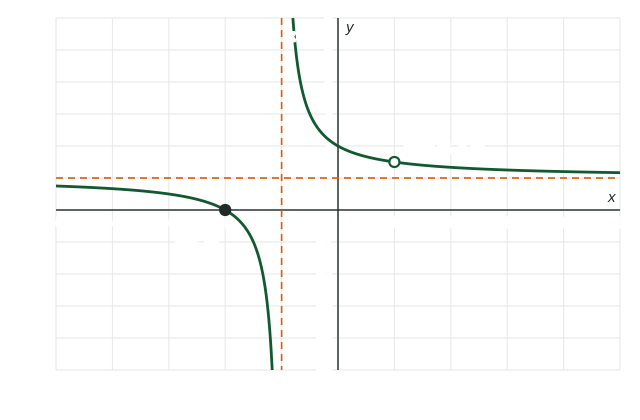
The graph of r(x) = (x² + x − 2)/(x² − 1), which equals (x + 2)/(x + 1) for x ≠ 1. It has a hole (open circle) at (1, 1.5), a dashed vertical asymptote x = −1 and a dashed horizontal asymptote y = 1. Its zero is x = −2.
r(x)r(x)=x2+x−2x2−1= \frac{x^2 + x - 2}{x^2 - 1}=x+2x+1= \frac{x + 2}{x + 1} for x≠1x \ne 1: a hole at (1,32)\left(1, \frac{3}{2}\right), a vertical asymptote x=−1x = -1 and a horizontal asymptote y=1y = 1. LevlPrep original diagram.

Part 5 · Step by step

How it works, step by step

  1. (x−a)(x - a) divides the numerator at least as many times as the denominatorit cancels completely from the denominator, and the graph has a hole at x=ax = a
  2. You cancel and evaluate the simplified formula at aayou get the hole's yy-coordinate LL, and limx→ar(x)=L\lim_{x \to a} r(x) = L
  3. The function itself is undefined at aathe point (a,L)(a, L) is drawn as an open circle, and aa is not a zero even if L=0L = 0

Part 6 · Key ideas

Key ideas

  • Hole at x=ax = a: the multiplicity of (x−a)(x - a) in the numerator is at least its multiplicity in the denominator.
  • Its height is limx→ar(x)\lim_{x \to a} r(x): cancel, then evaluate at aa.
  • Near a hole the outputs approach a number; near a vertical asymptote they grow without bound.
  • Write limx→ar(x)=L\lim_{x \to a} r(x) = L, never r(a)=Lr(a) = L: r(a)r(a) is undefined.

Part 7 · Misconception

A common mistake

The wrong idea: If the numerator and denominator are both 00 at x=ax = a, then r(a)=0r(a) = 0.

What actually happens: 00\frac{0}{0} has no value. Cancel the common factor and evaluate the rest: for x2−x−6x2−5x+6\frac{x^2 - x - 6}{x^2 - 5x + 6} at x=3x = 3 that gives 55, the height of a hole.

Part 8 · Check yourself

Check yourself

Exam-style questions. Anything you miss goes into your review queue.

Graph

The graph of r(x)r(x)=x2−x−6x2−5x+6= \frac{x^2 - x - 6}{x^2 - 5x + 6}

−6−5−4−3−2−112345678−6−4−2246810xyr

1. The graph shows r(x)r(x)=x2−x−6x2−5x+6= \frac{x^2 - x - 6}{x^2 - 5x + 6}. Where is the hole in the graph of rr?

  1. At (2,4)(2, 4)
  2. At (3,0)(3, 0)
  3. At (3,5)(3, 5)
  4. At (−2,0)(-2, 0)
Show the answer

Factor: (x−3)(x+2)(x−2)(x−3)\frac{(x - 3)(x + 2)}{(x - 2)(x - 3)}. The factor x−3x - 3 has the same multiplicity on top and bottom, so x=3x = 3 is a hole; its yy-coordinate is 3+23−2=5\frac{3 + 2}{3 - 2} = 5.

  • At (2,4)(2, 4): At x=2x = 2 only the denominator has a factor x−2x - 2: that is the vertical asymptote.
  • At (3,0)(3, 0): x=3x = 3 is right, but the hole's height is the limit there, 3+23−2=5\frac{3 + 2}{3 - 2} = 5.
  • Correct: At (3,5)(3, 5): Right: x−3x - 3 cancels, and the remaining x+2x−2\frac{x + 2}{x - 2} is 55 at x=3x = 3.
  • At (−2,0)(-2, 0): (−2,0)(-2, 0) is on the graph: it is a zero.

2. The graph shows r(x)r(x)=x2−x−6x2−5x+6= \frac{x^2 - x - 6}{x^2 - 5x + 6}. Which statement is true?

  1. r(3)=5r(3) = 5
  2. limx→3r(x)=5\lim_{x \to 3} r(x) = 5
  3. limx→3r(x)=∞\lim_{x \to 3} r(x) = \infty
  4. limx→3r(x)=0\lim_{x \to 3} r(x) = 0
Show the answer

For x≠3x \ne 3, r(x)=x+2x−2r(x) = \frac{x + 2}{x - 2}, which approaches 55 as x→3x \to 3. So limx→3r(x)=5\lim_{x \to 3} r(x) = 5 while r(3)r(3) is undefined.

  • r(3)=5r(3) = 5: r(3)r(3) is undefined: the original denominator is 00 at x=3x = 3.
  • Correct: limx→3r(x)=5\lim_{x \to 3} r(x) = 5: Right: the outputs approach 55 from both sides, though r(3)r(3) does not exist.
  • limx→3r(x)=∞\lim_{x \to 3} r(x) = \infty: Near x=3x = 3 the outputs stay close to 55; they grow without bound only near x=2x = 2.
  • limx→3r(x)=0\lim_{x \to 3} r(x) = 0: 0÷00 \div 0 is not 00; cancel the common factor and evaluate.

3. The graph shows r(x)r(x)=x2−x−6x2−5x+6= \frac{x^2 - x - 6}{x^2 - 5x + 6}. Which describes rr near its vertical asymptote?

  1. limx→2−r(x)=−∞\lim_{x \to 2^-} r(x) = -\infty and limx→2+r(x)=∞\lim_{x \to 2^+} r(x) = \infty
  2. limx→2−r(x)=∞\lim_{x \to 2^-} r(x) = \infty and limx→2+r(x)=−∞\lim_{x \to 2^+} r(x) = -\infty
  3. limx→3−r(x)=−∞\lim_{x \to 3^-} r(x) = -\infty and limx→3+r(x)=∞\lim_{x \to 3^+} r(x) = \infty
  4. limx→2r(x)=4\lim_{x \to 2} r(x) = 4
Show the answer

Near x=2x = 2: top x+2≈4>0x + 2 \approx 4 > 0; bottom x−2x - 2 negative on the left, positive on the right.

  • Correct: limx→2−r(x)=−∞\lim_{x \to 2^-} r(x) = -\infty and limx→2+r(x)=∞\lim_{x \to 2^+} r(x) = \infty: Right: x+2x−2\frac{x + 2}{x - 2} has a positive top and a denominator that changes sign at 22.
  • limx→2−r(x)=∞\lim_{x \to 2^-} r(x) = \infty and limx→2+r(x)=−∞\lim_{x \to 2^+} r(x) = -\infty: Test x=1.9x = 1.9: 3.9−0.1=−39\frac{3.9}{-0.1} = -39, so the left side goes down.
  • limx→3−r(x)=−∞\lim_{x \to 3^-} r(x) = -\infty and limx→3+r(x)=∞\lim_{x \to 3^+} r(x) = \infty: x=3x = 3 is the hole; the vertical asymptote is x=2x = 2.
  • limx→2r(x)=4\lim_{x \to 2} r(x) = 4: The outputs near 22 grow without bound; 44 is the numerator's value there.

Table

Outputs near x=−1x = -1

Values of k(x) = (x^2 - 1)/(x + 1) for inputs close to -1; k(-1) is undefined
xx-1.1-1.01-1.001-0.999-0.99-0.9
k(x)k(x)-2.1-2.01-2.001-1.999-1.99-1.9

4. The table gives values of k(x)=x2−1x+1k(x) = \frac{x^2 - 1}{x + 1} near x=−1x = -1. What is limx→−1k(x)\lim_{x \to -1} k(x)?

  1. −2-2
  2. −1-1
  3. −∞-\infty
  4. It does not exist, because k(−1)k(-1) is undefined
Show the answer

−2.1,−2.01,−2.001-2.1, -2.01, -2.001 from the left and −1.999,−1.99,−1.9-1.999, -1.99, -1.9 from the right close in on −2-2. Algebra agrees: k(x)=x−1k(x) = x - 1 for x≠−1x \ne -1.

  • Correct: −2-2: Right: the outputs approach −2-2 from both sides.
  • −1-1: −1-1 is the input being approached, not the limit of the outputs.
  • −∞-\infty: The outputs stay near −2-2; they do not grow in size.
  • It does not exist, because k(−1)k(-1) is undefined: A limit describes nearby inputs; it can exist even where the function is undefined.

5. The table gives values of k(x)=x2−1x+1k(x) = \frac{x^2 - 1}{x + 1} near x=−1x = -1. What feature does the graph of kk have at x=−1x = -1?

  1. A vertical asymptote x=−1x = -1
  2. A zero at x=−1x = -1
  3. A hole at (−1,−2)(-1, -2)
  4. A hole at (−1,0)(-1, 0)
Show the answer

x+1x + 1 appears once on top (x2−1=(x−1)(x+1)x^2 - 1 = (x - 1)(x + 1)) and once below, so it cancels: a hole where the outputs would be −1−1=−2-1 - 1 = -2.

  • A vertical asymptote x=−1x = -1: Near an asymptote the outputs grow without bound; here they stay near −2-2.
  • A zero at x=−1x = -1: k(−1)k(-1) is undefined, so −1-1 cannot be a zero.
  • Correct: A hole at (−1,−2)(-1, -2): Right: the graph is the line y=x−1y = x - 1 with that one point missing.
  • A hole at (−1,0)(-1, 0): The hole's height is the limit, −2-2, not the value of the numerator.

6. Which function has a hole at x=1x = 1?

  1. x−1(x−1)2\frac{x - 1}{(x - 1)^2}
  2. (x−1)2x−1\frac{(x - 1)^2}{x - 1}
  3. x+1x−1\frac{x + 1}{x - 1}
  4. x−1x+1\frac{x - 1}{x + 1}
Show the answer

A hole at x=ax = a needs (x−a)(x - a) in the denominator with multiplicity no greater than in the numerator. (x−1)2x−1\frac{(x - 1)^2}{x - 1}=x−1= x - 1 for x≠1x \ne 1: a hole at (1,0)(1, 0).

  • x−1(x−1)2\frac{x - 1}{(x - 1)^2}: x−1x - 1 appears more often below, so x=1x = 1 is a vertical asymptote.
  • Correct: (x−1)2x−1\frac{(x - 1)^2}{x - 1}: Right: the numerator's multiplicity (22) is at least the denominator's (11).
  • x+1x−1\frac{x + 1}{x - 1}: Only the denominator is 00 at 11: a vertical asymptote.
  • x−1x+1\frac{x - 1}{x + 1}: x=1x = 1 is a zero here, and −1-1 is an asymptote.

Part 9 · Summary

Summary

A rational function has a hole at x=ax = a when (x−a)(x - a) divides the numerator at least as often as the denominator. Cancel the factor and evaluate at aa to get the hole's height LL; then limx→ar(x)=L\lim_{x \to a} r(x) = L while r(a)r(a) is undefined. Near a hole the outputs approach a number, unlike near a vertical asymptote.
Part 10 · Up next

What comes next

Part 11 · Connections

Connections