Polynomial Functions and Complex Zeros
Each factor (x − a)^k of a polynomial gives a zero a of multiplicity k : the graph crosses at odd multiplicity and touches at even multiplicity.
Part 1 · Hook
Why this matters
Part 2 · Before you start
What this builds on
Part 3 · Prerequisite check
Quick check before you start
1. Solve .
Show the answer
, so .
- Correct: :
- :
- :
- :
2. What is the degree of ?
Show the answer
.
- Correct: :
- :
- :
- :
Part 4 · See it
See it first
Part 5 · Step by step
How it works, step by step
- is a factor of and no higher power is is a zero of multiplicity
- The multiplicity is even keeps its sign near : the graph touches the axis without crossing
- has degree it has exactly complex zeros counting multiplicity, real or not
- has real coefficients and a zero with its conjugate is a zero too
Part 6 · Key ideas
Key ideas
- Multiplicity: the power of the factor . Odd: the graph crosses. Even: it touches (a double zero bounces off the axis).
- Degree means complex zeros counting multiplicity; non-real ones come in conjugate pairs when the coefficients are real.
- Equally spaced inputs with constant th differences fit degree .
- Even function: , symmetric about the -axis. Odd function: , symmetric about the origin.
Part 7 · Misconception
A common mistake
The wrong idea: A polynomial of degree always has -intercepts.
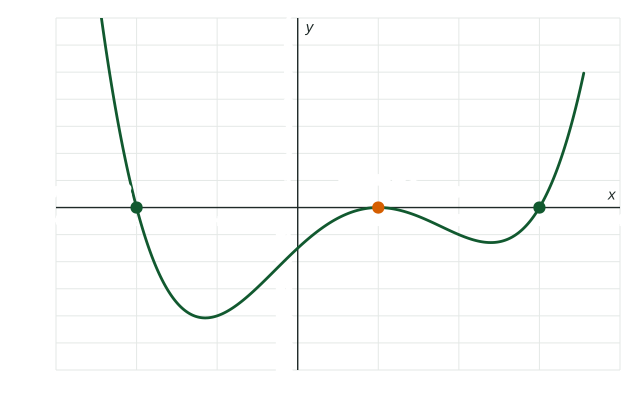
What actually happens: It has complex zeros counting multiplicity, but some may repeat and some may be non-real. The in the figure has degree and only -intercepts, because the zero counts twice.
Part 8 · Check yourself
Check yourself
Exam-style questions. Anything you miss goes into your review queue.
Graph
The graph of a polynomial function
1. The graph shows a polynomial function of degree . Which zero of has even multiplicity?
Show the answer
At a zero of even multiplicity the factor is squared (or raised to another even power), so it does not change sign: the graph touches the -axis without crossing.
- : The graph crosses the axis at , which goes with odd multiplicity.
- : The graph crosses at as well: odd multiplicity.
- Correct: : Right: the graph touches the axis at and turns back without crossing.
- : , so is not a zero at all.
2. Which could be a formula for ?
Show the answer
A zero at gives a factor . The touching zero needs . Then check one point: at the formula must give the graph's .
- : This has the right zeros but the opposite sign: its output at is , below the axis.
- : Degree , and appears once, so the graph would cross there.
- : These zeros are , and , the opposites of the ones on the graph.
- Correct: : Right: zeros , (squared) and , and
matches the graph.
3. has degree . How many complex zeros does have, counting multiplicity?
No calculator. Type the exact value (a fraction, π, e or a root is fine).
Show the answer
A polynomial of degree has exactly complex zeros, counting multiplicity. Here: (once), (twice) and (once), in all, all of them real.
- Answer: 4
Table
Equally spaced outputs
| 0 | 1 | 2 | 3 | 4 | 5 | |
|---|---|---|---|---|---|---|
| 1 | 0 | 1 | 10 | 33 | 76 |
4. For the outputs in the table, which differences are constant?
- The first differences, each equal to
- The second differences, each equal to
- The third differences, each equal to
- No level of differences is constant
Show the answer
First differences ; second ; third . Constant third differences over equal steps fit a polynomial of degree .
- The first differences, each equal to : The first differences are .
- The second differences, each equal to : The second differences are ; they change by .
- Correct: The third differences, each equal to : Right: , , .
- No level of differences is constant: Keep differencing: the third differences settle at .
5. Using only the differences, what is ?
No calculator. Type the exact value (a fraction, π, e or a root is fine).
Show the answer
Next third difference ; next second difference ; next first difference ; so . Check: .
- Answer: 145
6. A polynomial function with real coefficients has as a zero. Which must also be a zero?
Show the answer
With real coefficients, the non-real zeros come in conjugate pairs . So is also a zero.
- : This negates both parts; the conjugate changes only the sign of the imaginary part.
- Correct: : Right: non-real zeros of a polynomial with real coefficients come in conjugate pairs.
- : The real part stays .
- : Only the complex conjugate of is forced to be a zero.
Part 9 · Summary
Summary
Part 10 · Up next
What comes next
Part 11 · Connections