
A quadratic whose graph misses the -axis has no real zeros, but the quadratic formula still produces answers: they just involve the square root of a negative number. Topic 1.5 counts every zero of a polynomial function, real or not, so this page covers what those answers mean and how to compute with them.
The imaginary unit
No real number squares to . The imaginary unit is defined by . Then every negative number has square roots: , since .
A complex number has the form with and real. is the real part and the imaginary part. Real numbers are the complex numbers with .
Arithmetic
Add and subtract real parts and imaginary parts separately:
Multiply like binomials, then replace with .
Worked example 1. Multiply .
Distribute: .
Replace : . Combine:
Powers of repeat in a cycle of four:
Complex conjugates
The complex conjugate of is . A number times its conjugate is always real:
For example,
Quadratics with no real solutions
Worked example 2. Solve .
Discriminant: . Negative, so no real solutions.
Quadratic formula:
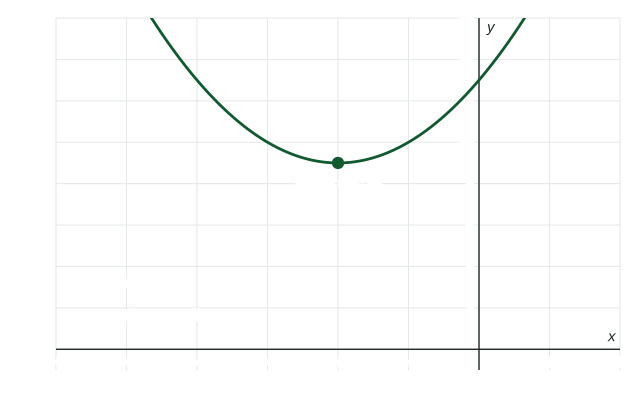
The two solutions are complex conjugates of each other. That is no accident: the in the formula produces and together whenever the coefficients are real and the discriminant is negative. Topic 1.5 extends this pairing to every polynomial function with real coefficients.