The next topic puts angles on a circle and reads sine and cosine as coordinates. Three tools make that easy: two right triangles whose sides you know exactly, the length of an arc, and the equation of a circle.
The two special right triangles
Most right triangles have messy side ratios. Two have ratios you can write exactly, and they appear again and again.
45-45-90. Two equal angles mean two equal legs. With legs , the Pythagorean theorem gives a hypotenuse of . Any 45-45-90 triangle is a scaled copy: legs , hypotenuse .
30-60-90. Cut an equilateral triangle with sides down the middle. Each half has a hypotenuse , a short leg (half the base) and a long leg . The short leg is across from , the long leg across from .
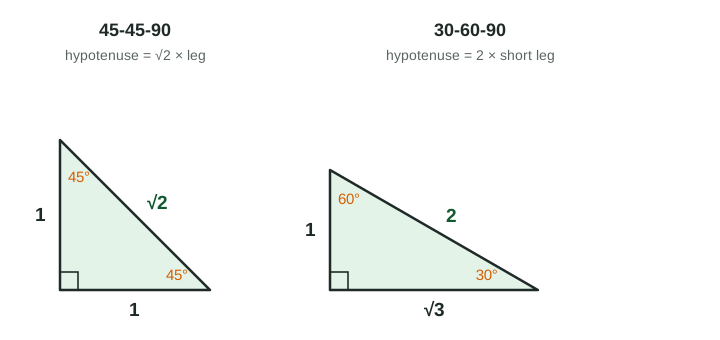
Reading SOH CAH TOA off these triangles gives exact values:
| Angle | |||
|---|---|---|---|
( and are the same number: multiply top and bottom by .)
Worked example 1. A 30-60-90 triangle has hypotenuse . Find both legs.
Scale so the hypotenuse is : multiply by . The short leg is and the long leg is .
Arc length
A central angle has its vertex at the center of a circle. An angle of degrees is the fraction of a full turn, so it cuts off that fraction of the circumference :
.
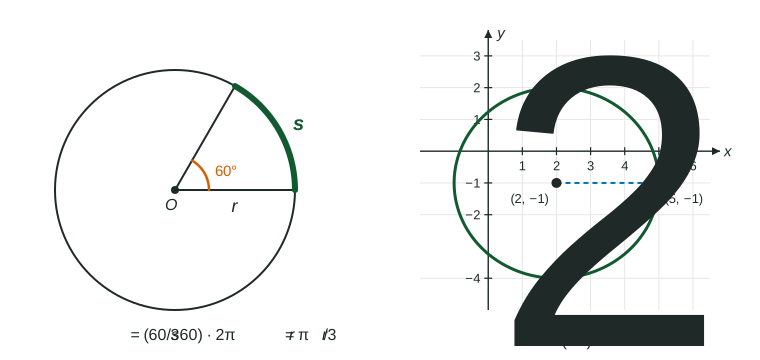
Worked example 2. A circle has radius 9 cm. How long is the arc cut off by a central angle of ?
Notice what happens when the arc is exactly as long as the radius: gives
The equation of a circle
A circle is every point at distance from its center . The horizontal and vertical distances from the center, and , are the legs of a right triangle with hypotenuse . The Pythagorean theorem gives
.
Watch the signs: a center at gives . And the right side is the radius squared: radius means .
The simplest case is the circle of radius centered at the origin, . The point on it reached by turning up from the positive -axis is the top corner of a 30-60-90 triangle with hypotenuse : it is