In a right triangle, sine and cosine only make sense for angles between and . To model a turning wheel or a tide you need them for every angle, including angles bigger than a full turn and negative angles. The fix is to put the angle on a circle. This page sets up the three ideas the rest of the unit is built on: radians, the unit circle, and sine, cosine and tangent as coordinates and a slope.
Radians: measuring angles by arcs
An angle at the center of a circle cuts off an arc. The bigger the circle, the longer the arc, but the ratio arc length over radius depends only on the angle. That ratio is the angle's radian measure:
(radians), so .
A full turn cuts off the whole circumference: radians. So and
.
One radian is the angle whose arc is exactly one radius long, about . Calculus and this course use radians by default: when an angle has no degree sign, it is in radians.
Worked example 1. Convert to radians and to degrees.
Multiply degrees by : .
Multiply radians by : .
| Degrees | ||||||||
|---|---|---|---|---|---|---|---|---|
| Radians |
Angles in standard position
An angle is in standard position when its vertex is at the origin and its initial ray lies along the positive -axis. It turns to its terminal ray: counterclockwise for a positive angle, clockwise for a negative one. Turning more than just goes around again, so and have the same terminal ray. So do and , , and so on.
Sine and cosine on the unit circle
The unit circle is the circle of radius 1 centered at the origin, . The terminal ray of meets it at exactly one point . By definition,
-coordinate of , -coordinate of , so .
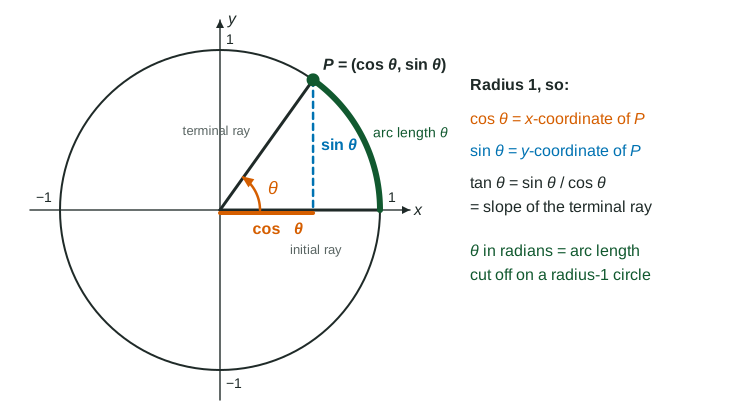
For an acute angle this matches the triangle definition: drop a segment from to the -axis and you get a right triangle with hypotenuse 1, so opposite and adjacent . The circle version also works for angles the triangle cannot handle. Because the radius is 1, the angle in radians is also the length of the arc from to : sine and cosine turn an arc length into a coordinate.
The four points on the axes give values you should know at a glance:
| Point | |||
|---|---|---|---|
The quadrant of sets the signs. In Quadrant I both are positive; in Quadrant II, and ; in Quadrant III both are negative; in Quadrant IV, and .
Tangent as a slope
The terminal ray goes through the origin and , so its slope is rise over run, . That slope is :
, defined when .
At the ray is vertical, , and is undefined. Any point on the ray gives the same slope, not only .
Worked example 2. The terminal ray of meets the unit circle at . Find , and , and say where lies if .
Read the coordinates: and . Then
is in Quadrant II, so .
Worked example 3. A point on the rim of a wheel of radius 30 cm moves 90 cm along the rim. Through what angle has the wheel turned, and where is the point if it started on the positive -axis and turned counterclockwise?
radians. Since
Why this makes sine and cosine periodic
Adding to an angle brings its terminal ray back to the same place, so
and .
So sine and cosine are periodic, with period . The next topic finds their exact values at the angles you meet most, and the one after draws their graphs.