In Topic 3.13 a single pair named a single point. Now let depend on . As the direction sweeps around the pole, the distance changes, and the points trace a curve. This page shows how to read and sketch such curves from the ordinary graph of against , and names the families you will see.
A function of the angle
A polar function has the angle as its input and a signed distance as its output. Its graph is the set of points with polar coordinates . You can also graph against on ordinary axes, with across and up. The two pictures carry the same information:
| On the graph of against | On the polar curve |
|---|---|
| moving right (input increases) | the direction turns counterclockwise |
| height (output) | signed distance along the current ray |
| a zero, | the curve passes through the pole |
| (below the axis) | the point is on the opposite ray |
| a peak or valley of | a point farthest from the pole nearby, such as a petal tip |
Sketching from the graph of
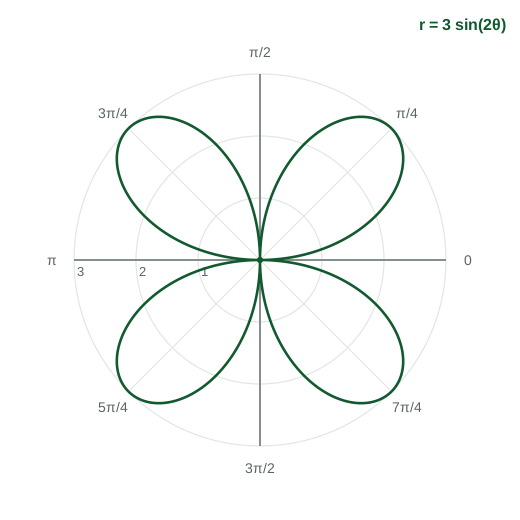
Worked example 1. Sketch (Figure 1).
Key values. at ; at and ; at and .
First quarter turn, : rises from to and falls back to , all positive. The points leave the pole, reach distance along the ray , and return: one petal in Quadrant I.
Second quarter turn, : is negative. The angle points into Quadrant II, so the points land in Quadrant IV: a petal there, with its tip at , which is the same point as .
The next two quarter turns draw petals in Quadrants III and II. Four humps, four petals.
The families
| Equation | Name | Shape |
|---|---|---|
| circle | radius , centered at the pole | |
| , | circle | diameter , through the pole, centered on an axis |
| (or ), | limaçon with inner loop | passes through the pole twice |
| cardioid | heart shape, touches the pole once | |
| limaçon without a loop | never reaches the pole | |
| , | rose | petals if is odd, if is even, each of length |
Cosine versions are symmetric about the polar axis; sine versions are symmetric about the vertical line .
The inner loop
Worked example 2. Where does form its inner loop?
where : and . Between them, ; at , .
On the angle points left, but the negative puts the points to the right of the pole. The small loop runs from the pole out to in rectangular coordinates and back. Outside that interval and the big loop is drawn, reaching at .
Common slips
- Plotting a negative in the quadrant the angle points to. Reverse through the pole.
- Counting petals as when is even. Even gives .
- Confusing (a circle through the pole) with (a circle around the pole).