Two expressions can look nothing alike and still have the same graph. 1 − 2 sin 2 x 1 - 2\sin^2 x cos ( 2 x ) \cos(2x) input where both sides are defined is an identity . On the exam, identities do three jobs: they turn an angle like π 12 \frac{\pi}{12} trigonometric function , and they turn a hard equation into one you can solve.
The Pythagorean identity
The point ( cos x , sin x ) (\cos x, \sin x) unit circle X 2 + Y 2 = 1 X^2 + Y^2 = 1
sin 2 x + cos 2 x = 1 \sin^2 x + \cos^2 x = 1
for every x x sin 2 x \sin^2 x ( sin x ) 2 (\sin x)^2 cos 2 x \cos^2 x sin 2 x \sin^2 x
tan 2 x + 1 = sec 2 x 1 + cot 2 x = csc 2 x \tan^2 x + 1 = \sec^2 x \qquad 1 + \cot^2 x = \csc^2 x
Use them to find one value from another. If sin x = 3 5 \sin x = \frac{3}{5} x x cos 2 x \cos^2 x = 1 − 9 25 = 1 - \frac{9}{25} = 16 25 = \frac{16}{25} cos x = − 4 5 \cos x = -\frac{4}{5}
Sum and difference identities
sin ( a ± b ) = sin a cos b ± cos a sin b \sin(a \pm b) = \sin a\cos b \pm \cos a\sin b
cos ( a ± b ) = cos a cos b ∓ sin a sin b \cos(a \pm b) = \cos a\cos b \mp \sin a\sin b
Watch the signs in the cosine identity: a sum gives a minus, a difference gives a plus. And notice what they say is false: sin ( a + b ) \sin(a + b) sin a + sin b \sin a + \sin b
Worked example 1. Find sin 5 π 12 \sin\frac{5\pi}{12}
Write 5 π 12 = π 4 + π 6 \frac{5\pi}{12} = \frac{\pi}{4} + \frac{\pi}{6}
sin ( π 4 + π 6 ) \sin\left(\frac{\pi}{4} + \frac{\pi}{6}\right) = sin π 4 cos π 6 = \sin\frac{\pi}{4}\cos\frac{\pi}{6} + cos π 4 sin π 6 + \cos\frac{\pi}{4}\sin\frac{\pi}{6} = 2 2 ⋅ 3 2 = \frac{\sqrt{2}}{2}\cdot\frac{\sqrt{3}}{2} + 2 2 ⋅ 1 2 + \frac{\sqrt{2}}{2}\cdot\frac{1}{2} = 6 + 2 4 = \frac{\sqrt{6} + \sqrt{2}}{4}
The difference identities also explain the phase shift between the graphs: cos ( x − π 2 ) \cos\left(x - \frac{\pi}{2}\right) = cos x ⋅ 0 = \cos x\cdot 0 + sin x ⋅ 1 + \sin x\cdot 1 = sin x = \sin x
Double-angle identities
Put b = a b = a
sin ( 2 a ) = 2 sin a cos a \sin(2a) = 2\sin a\cos a
cos ( 2 a ) = cos 2 a − sin 2 a = 2 cos 2 a − 1 = 1 − 2 sin 2 a \cos(2a) = \cos^2 a - \sin^2 a = 2\cos^2 a - 1 = 1 - 2\sin^2 a
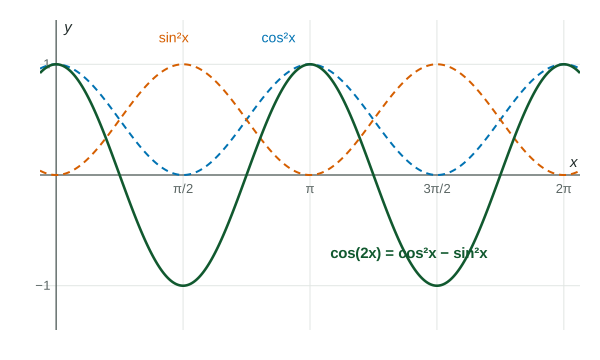
The last two forms come from replacing sin 2 a \sin^2 a cos 2 a \cos^2 a Pythagorean identity . Figure 1 shows the first form as heights on a graph.
Figure 1. cos ( 2 x ) \cos(2x) cos 2 x \cos^2 x sin 2 x \sin^2 x LevlPrep original diagram.
Family Identities Typical use
Pythagorean sin 2 x + cos 2 x = 1 \sin^2 x + \cos^2 x = 1 tan 2 x + 1 = sec 2 x \tan^2 x + 1 = \sec^2 x 1 + cot 2 x = csc 2 x 1 + \cot^2 x = \csc^2 x replace a square; find one ratio from another Sum and difference sin ( a ± b ) \sin(a \pm b) cos ( a ± b ) \cos(a \pm b) exact values at angles like π 12 \frac{\pi}{12} Double angle sin ( 2 a ) = 2 sin a cos a \sin(2a) = 2\sin a\cos a cos ( 2 a ) \cos(2a) an equation with 2 x 2x x x
Rewriting as a single function
When a question says "as a single trigonometric function", the answer is one function like tan x \tan x sin x cos x \frac{\sin x}{\cos x}
Write every function in terms of sin \sin cos \cos 2 x 2x
Use a Pythagorean identity to replace sums of squares.
Cancel common factors.
Name the one function that is left.
Worked example 2. Rewrite 1 − cos ( 2 x ) sin ( 2 x ) \frac{1 - \cos(2x)}{\sin(2x)}
Choose the form of cos ( 2 x ) \cos(2x) 1 1 1 − cos ( 2 x ) 1 - \cos(2x) = 1 − ( 1 − 2 sin 2 x ) = 1 - (1 - 2\sin^2 x) = 2 sin 2 x = 2\sin^2 x
Expand the bottom: sin ( 2 x ) = 2 sin x cos x \sin(2x) = 2\sin x\cos x
Cancel: 2 sin 2 x 2 sin x cos x \frac{2\sin^2 x}{2\sin x\cos x} = sin x cos x = \frac{\sin x}{\cos x} = tan x = \tan x
Solving equations with identities
An equation that mixes sin ( 2 x ) \sin(2x) sin x \sin x
Worked example 3. Solve cos ( 2 x ) = cos x \cos(2x) = \cos x [ 0 , 2 π ) [0, 2\pi)
Use the form with only cosines: 2 cos 2 x − 1 = cos x 2\cos^2 x - 1 = \cos x 2 cos 2 x − cos x − 1 = 0 2\cos^2 x - \cos x - 1 = 0
Factor: ( 2 cos x + 1 ) ( cos x − 1 ) (2\cos x + 1)(\cos x - 1) = 0 = 0 cos x = − 1 2 \cos x = -\frac{1}{2} x = 2 π 3 , 4 π 3 x = \frac{2\pi}{3}, \frac{4\pi}{3} cos x = 1 \cos x = 1 x = 0 x = 0
Answer: x = 0 x = 0 2 π 3 \frac{2\pi}{3} 4 π 3 \frac{4\pi}{3}
Common slips
Splitting a function over a sum: cos ( a + b ) ≠ cos a + cos b \cos(a + b) \ne \cos a + \cos b
Pulling the 2 2 sin ( 2 x ) \sin(2x)
Stopping at sin x cos x \frac{\sin x}{\cos x}
Dividing an equation by sin x \sin x sin x = 0 \sin x = 0