Every sinusoidal function can be written with one formula,
where and are not zero. Each constant is one of the transformations from Unit 1 applied to the sine graph. This page shows what each one does, then how to run the process backward: read a graph and write its formula.
What each constant does
| Constant | Transformation | Feature it sets |
|---|---|---|
| vertical dilation by ; reflection across the midline if | amplitude | |
| horizontal dilation by | period | |
| horizontal translation by | phase shift: left if | |
| vertical translation by | midline |
Why the period is . completes one cycle while runs from to , which happens while runs from to . A bigger squeezes more cycles into the same space, so the period shrinks. Turned around, this is the rule the exam asks for again and again:
.
In context the period is often hidden in a frequency. A spring that bounces 2 times per second has period second, so , not .
Why the shift is . The sine graph starts a cycle (crosses its midline going up) where its input is . For that is where , at . So moves the graph left. This is the same rule as moving a graph left 3.
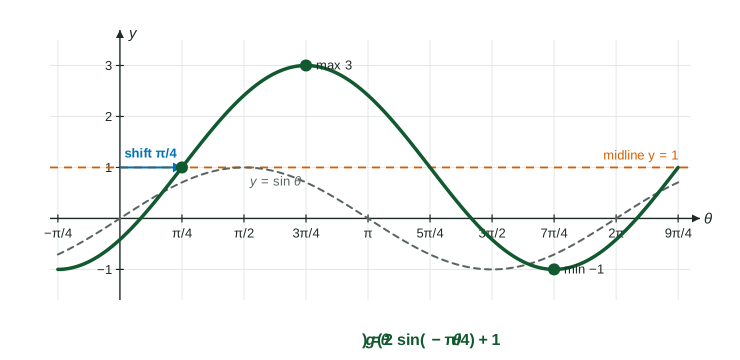
Worked example 1. Describe
Factor out of the input first: , so .
Amplitude , reflected across the midline. Period . Phase shift to the left. Midline , so the values run from to .
Sine and cosine are shifts of each other
Cosine is sine moved to the left: . So every sinusoid has a sine formula and a cosine formula. A reflection gives more: . On the exam, any correct formula earns the points; choose the one that makes easiest to read.
From a graph to a formula
- Midline: .
- Amplitude: .
- Period: measure one cycle, then .
- Shift: pick a landmark. For sine with , use a midline crossing where the graph is rising: . For cosine with , use a highest point. For cosine with , use a lowest point.
Worked example 2. A sinusoid has a highest point at and lowest points at and . Write a formula.
Midline . Amplitude . Period (lowest to lowest), so .
With cosine and , the highest point should sit where the input is ; here it is at , a shift right : .
With cosine and (a reflected cosine starts at a lowest point), the lowest point at needs no shift: . With sine and : the graph crosses the midline going up halfway between and , at , so
Worked example 3. Write a sinusoid with amplitude 2, period and midline whose graph crosses its midline going up at .
. A sine with already rises through its midline at , so : .
Common slips
- Reading the shift before factoring: shifts right , not .
- Using the period as , or the frequency as the period: is divided by the period.
- Using as the amplitude: it is half of that.
- Forgetting the sign of the shift: moves right, moves left.