Unit 3 · Topic 3.6
Sinusoidal Function Transformations
In f(θ) = asin (b(θ + c)) + d , |a| is the amplitude, 2π/(|b|) the period, c the phase shift (left by c ) and y = d the midline; cosine works the same way.
Practice 1: Procedural and Symbolic FluencyPractice 2: Multiple Representations
Part 1 · Hook
Why this matters
A music app draws a sound wave, and an engineer needs its formula to filter it: how tall, how fast, how far along. Every
sinusoid you will ever meet is
stretched, squeezed and slid. Four constants,
,
,
and
, record exactly how, and reading them correctly is the heart of the periodic modeling question on the exam.
Part 2 · Before you start
What this builds on
Part 3 · Prerequisite check
Quick check before you start
1. The greatest value of a sinusoidal function is and the least is . What is its midline?
Show the answer
The midline is the average of the extremes: .
- Correct: :
- :
- :
- :
2. The graph of is the graph of
- moved 3 units right
- moved 3 units left
- moved 3 units down
- stretched horizontally by 3
Show the answer
The input must be 3 larger to give the same output, so every point moves 3 units right.
- Correct: moved 3 units right:
- moved 3 units left:
- moved 3 units down:
- stretched horizontally by 3:
Part 5 · Step by step
How it works, step by step
- Multiply by : →a vertical dilation: the amplitude becomes , and a negative also reflects the graph across the midline
- Multiply the input by : →a horizontal dilation: one cycle now takes , so the period is and
- Add inside, after factoring out : →a phase shift: the graph moves left units if , right if
- Add outside: →a vertical translation: the midline becomes
Part 6 · Key ideas
Key ideas
- For or : amplitude , period , phase shift (left by ), midline .
- Factor out before reading the shift: moves left , not .
- Building from a graph: from the midline, from the amplitude, , then from one landmark (a rising midline crossing for sine, a highest point for cosine).
- Many formulas give the same graph: , and can change by any whole number of periods.
Part 7 · Misconception
A common mistake
The wrong idea: In the graph moves right , and the period is .
What actually happens: Factor first: , a shift right . Multiplying the input by 2 makes each cycle shorter, so the period is .
Part 8 · Check yourself
Check yourself
Exam-style questions. Anything you miss goes into your review queue.
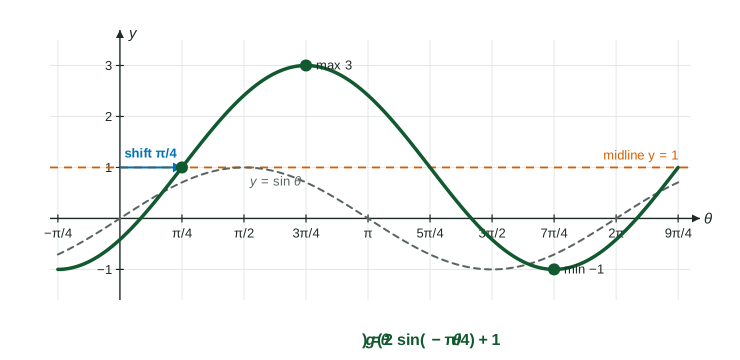
1. Write a formula for .
Type an expression for .
Show the answer
Midline , amplitude , period so . The graph rises through its midline at , so . Equivalent: .
- Answer:
2. The function can be written . Which value of works?
Show the answer
The sine pattern starts (rising midline crossing) at . On the graph that is , so .
- Correct: : Start of the cycle at means there.
- : This moves the graph left; it would rise through the midline at and fall through it at .
- : With the graph would have a lowest point at , but is at its midline there.
- : With no shift the graph would be at its midline at , but .
3. Which is also a formula for ?
Show the answer
is at and at : a reflected cosine starts at a lowest point, as does.
- Correct: : A reflected cosine: lowest at , highest at .
- : This has its highest point at ; has its lowest point there.
- : This is at , but .
- : , so this is at .
4. What is the average rate of change of on ?
No calculator. Type the exact value (a fraction, π, e or a root is fine).
Show the answer
, the slope of the secant line from the lowest point to the highest point.
- Answer: ≈ 1.910
5. What is the period of ?
No calculator. Type the exact value (a fraction, π, e or a root is fine).
Show the answer
Period .
- Answer: ≈ 2.094
6. How is the graph of shifted, compared with ?
- Left
- Left
- Right
- Right
Show the answer
Factor out : , so : a shift left .
- Correct: Left : After factoring out 2, the shift is to the left.
- Left : This reads the shift before factoring out .
- Right : A plus sign inside moves the graph left, not right.
- Right : Wrong direction, and was not factored out.
Part 9 · Summary
Summary
In
, is the amplitude, the period, the phase shift (left by ) and the midline; cosine works the same way. To build a formula from a graph, read and , get , then find from a landmark point. Factor out before reading a shift.Part 10 · Up next
What comes next
Part 11 · Connections
Connections