
Solving looks like a one-step job: press . But sine repeats, so the equation has infinitely many solutions, and the inverse key returns only one of them. This page gives a four-step routine that finds every solution in an interval, works for equations like and , and handles inequalities.
The routine: isolate, principal value, symmetry, period
- Isolate the trigonometric function: undo the outside operations until you have , or . If for sine or cosine, stop: there is no solution.
- Principal value: apply the inverse (or read the unit circle) to get one angle.
- Symmetry: find the other angle in the same period with the same value (Figure 1).
- Sine: , a mirror image across the -axis.
- Cosine: , a mirror image across the -axis, so also works.
- Tangent: one angle per period; the next is .
- Period: add or subtract the period ( for sine and cosine, for tangent) to reach every solution in the interval. Drop anything outside it.
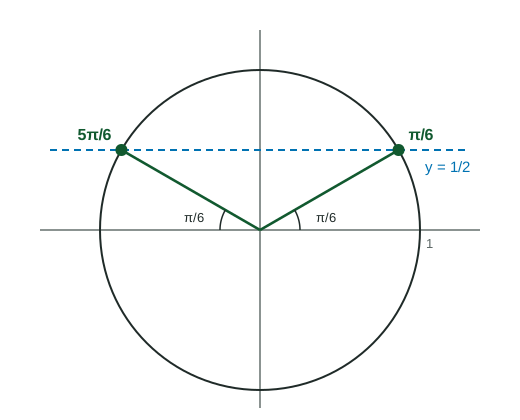
Worked example 1. Solve on .
Isolate: , so .
Principal value: .
Symmetry: has the same cosine; it is outside the interval, so add : .
Answer: and . On all real numbers: .
When the angle is
For , the inside runs through a stretched interval. If is in and , then is in : three periods, so up to six solutions. Solve for the inside first, then divide.
Worked example 2. Solve on .
Let . Since , we have .
: the principal value is , outside , so use . The mirror angle is .
So or , and or . Both are in .
Quadratic forms and factoring
Treat like a variable. factors as
- A square root has two signs: means .
- Never divide both sides by a trigonometric expression that can be . Factor it out instead: becomes , which keeps and .
Inequalities
Solve the matching equation. Its solutions split the interval into pieces; on each piece the inequality is either true everywhere or false everywhere. Test one value per piece.
Worked example 3. Solve on .
at and . Test : , true. Test : , false. So the solution is .
With a calculator
When the value is not on the unit circle, the routine still works with decimals. In radian mode, gives
Common slips
- Stopping at the principal value and missing the second solution.
- Listing an angle outside the interval, such as a negative principal value.
- For , forgetting to stretch the interval, or forgetting to divide by at the end.