Unit 3 · Topic 3.10

Trigonometric Equations and Inequalities

To solve a trigonometric equation, isolate the function, take the principal value with the inverse, find the second angle by symmetry, then add periods until you have every solution in the interval and none outside it.

Practice 1: Procedural and Symbolic Fluency

Part 1 · Hook

Why this matters

A weight bounces on a spring, and you want every moment it passes a mark. One inverse key on a calculator gives one moment. The motion repeats, so there are more, and the exam's point goes to the student who finds every one of them in the interval and nothing outside it.

Part 2 · Before you start

What this builds on

Part 3 · Prerequisite check

Quick check before you start

1. What is sin−1⁡(12)\sin^{-1}\left(\frac{1}{2}\right)?

  1. π6\frac{\pi}{6}
  2. 5π6\frac{5\pi}{6}
  3. π3\frac{\pi}{3}
  4. 22
Show the answer

The angle in [−π2,π2]\left[-\frac{\pi}{2}, \frac{\pi}{2}\right] with sine 12\frac{1}{2} is π6\frac{\pi}{6}.

  • Correct: π6\frac{\pi}{6}:
  • 5π6\frac{5\pi}{6}:
  • π3\frac{\pi}{3}:
  • 22:

2. What is the period of y=cos⁡(2x)y = \cos(2x)?

  1. π\pi
  2. 2π2\pi
  3. 4π4\pi
  4. π2\frac{\pi}{2}
Show the answer

The period of cos⁡(bx)\cos(bx) is 2π|b|=2π2=π\frac{2\pi}{|b|} = \frac{2\pi}{2} = \pi.

  • Correct: π\pi:
  • 2π2\pi:
  • 4π4\pi:
  • π2\frac{\pi}{2}:

Part 4 · See it

See it first

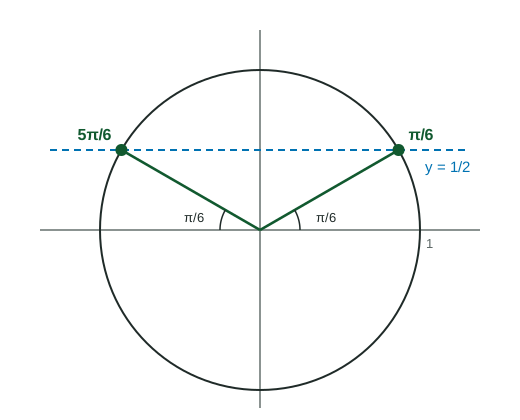
A unit circle with the horizontal line y = 1/2 crossing it at two points: one on the terminal ray of pi/6 in Quadrant I and one on the terminal ray of 5 pi/6 in Quadrant II. The two rays are mirror images across the y-axis.
Two angles in [0,2π)[0, 2\pi) have sine 12\frac{1}{2}: the principal value π6\frac{\pi}{6} and its mirror image π−π6\pi - \frac{\pi}{6}. LevlPrep original diagram.

Part 5 · Step by step

How it works, step by step

  1. Isolate the trigonometric functionan equation like sin⁡x=12\sin x = \frac{1}{2}
  2. Apply the inverseone principal value, such as π6\frac{\pi}{6}
  3. Use symmetry (π−x\pi - x for sine, −x-x for cosine)the second angle in the same period
  4. Add or subtract periodsevery solution in the interval, and no extras

Part 6 · Key ideas

Key ideas

  • Sine and cosine take most values twice per period; the inverse key gives only one of them.
  • Second angle: π−θ\pi - \theta for sine, 2π−θ2\pi - \theta (or −θ-\theta) for cosine, θ+π\theta + \pi for tangent.
  • For sin⁡(bx)=k\sin(bx) = k, solve for bxbx on the stretched interval first, then divide by bb.
  • For an inequality, solve the equation, then test one value in each piece.

Part 7 · Misconception

A common mistake

The wrong idea: The solution of sin⁡x=12\sin x = \frac{1}{2} is x=sin−1⁡12=π6x = \sin^{-1}\frac{1}{2} = \frac{\pi}{6}.

What actually happens: π6\frac{\pi}{6} is one solution. On [0,2π)[0, 2\pi), 5π6\frac{5\pi}{6} also works, and on all real numbers the solutions are π6+2kπ\frac{\pi}{6} + 2k\pi and 5π6+2kπ\frac{5\pi}{6} + 2k\pi.

Part 8 · Check yourself

Check yourself

Exam-style questions. Anything you miss goes into your review queue.

Graph

The graphs of y=2sin⁡xy = 2\sin x and y=1y = 1

0π/2π3π/22π5π/23π7π/24π−3−2−1123xyy = 1y = 2 sin x

1. Using the graph, find every solution of 2sin⁡x=12\sin x = 1 on [0,2π)[0, 2\pi).

  1. x=π6x = \frac{\pi}{6} and x=5π6x = \frac{5\pi}{6}
  2. x=π6x = \frac{\pi}{6}
  3. x=π6x = \frac{\pi}{6} and x=7π6x = \frac{7\pi}{6}
  4. x=π3x = \frac{\pi}{3} and x=2π3x = \frac{2\pi}{3}
Show the answer

Isolate: sin⁡x=12\sin x = \frac{1}{2}. The principal value is sin−1⁡12=π6\sin^{-1}\frac{1}{2} = \frac{\pi}{6}. Sine is also positive in Quadrant II, at π−π6=5π6\pi - \frac{\pi}{6} = \frac{5\pi}{6}. On the graph, the line y=1y = 1 crosses the curve twice in [0,2π)[0, 2\pi).

  • Correct: x=π6x = \frac{\pi}{6} and x=5π6x = \frac{5\pi}{6}: Right: the principal value and its Quadrant II partner.
  • x=π6x = \frac{\pi}{6}: This misses the second solution, π−π6=5π6\pi - \frac{\pi}{6} = \frac{5\pi}{6}, where the line crosses the curve again.
  • x=π6x = \frac{\pi}{6} and x=7π6x = \frac{7\pi}{6}: Adding π\pi works for tangent; sin⁡7π6=−12\sin\frac{7\pi}{6} = -\frac{1}{2}, not 12\frac{1}{2}.
  • x=π3x = \frac{\pi}{3} and x=2π3x = \frac{2\pi}{3}: These solve sin⁡x=32\sin x = \frac{\sqrt{3}}{2}; here sin⁡x=12\sin x = \frac{1}{2}.

2. Using the graph, solve the inequality 2sin⁡x>12\sin x > 1 on [0,2π)[0, 2\pi).

  1. (π6,5π6)\left(\frac{\pi}{6}, \frac{5\pi}{6}\right)
  2. [0,π6)∪(5π6,2π)\left[0, \frac{\pi}{6}\right) \cup \left(\frac{5\pi}{6}, 2\pi\right)
  3. (π6,2π)\left(\frac{\pi}{6}, 2\pi\right)
  4. (π3,2π3)\left(\frac{\pi}{3}, \frac{2\pi}{3}\right)
Show the answer

First solve the equation: 2sin⁡x=12\sin x = 1 at π6\frac{\pi}{6} and 5π6\frac{5\pi}{6}. These cut [0,2π)[0, 2\pi) into intervals. The curve is above the line y=1y = 1 only between them, so the solution is (π6,5π6)\left(\frac{\pi}{6}, \frac{5\pi}{6}\right). Check a test value: 2sin⁡π2=2>12\sin\frac{\pi}{2} = 2 > 1.

  • Correct: (π6,5π6)\left(\frac{\pi}{6}, \frac{5\pi}{6}\right): Right: the curve is above the line between the two crossings.
  • [0,π6)∪(5π6,2π)\left[0, \frac{\pi}{6}\right) \cup \left(\frac{5\pi}{6}, 2\pi\right): That is where 2sin⁡x<12\sin x < 1, below the line.
  • (π6,2π)\left(\frac{\pi}{6}, 2\pi\right): After 5π6\frac{5\pi}{6} the curve drops below the line again.
  • (π3,2π3)\left(\frac{\pi}{3}, \frac{2\pi}{3}\right): These endpoints solve sin⁡x=32\sin x = \frac{\sqrt{3}}{2}, not sin⁡x=12\sin x = \frac{1}{2}.

Graph

A weight on a spring: y(t)=4+3cos⁡(2t)y(t) = 4 + 3\cos(2t)

The height of a weight on a spring is y(t)=4+3cos⁡(2t)y(t) = 4 + 3\cos(2t) centimeters above a table, tt seconds after it is released, for 0≤t≤50 \le t \le 5. The dashed line is y=5y = 5. Use a calculator in radian mode.

012345012345678t (seconds)y (cm)y = 5

3. Find the smallest time tt in [0,5][0, 5] at which the weight is 55 centimeters above the table. Give tt correct to three decimal places.

Calculator allowed. Give the answer correct to three decimal places, in seconds.

Show the answer

Solve 4+3cos⁡(2t)=54 + 3\cos(2t) = 5: cos⁡(2t)=13\cos(2t) = \frac{1}{3}, so 2t2t=cos−1⁡(13)= \cos^{-1}\left(\frac{1}{3}\right)≈1.230959\approx 1.230959 and t≈0.615480t \approx 0.615480 seconds (radian mode). Or graph y=4+3cos⁡(2t)y = 4 + 3\cos(2t) and y=5y = 5 and find the first intersection.

  • Answer: 0.615 seconds

4. On which intervals of [0,5][0, 5] is the weight more than 55 centimeters above the table?

  1. [0,0.615)[0, 0.615) and (2.526,3.757)(2.526, 3.757)
  2. (0.615,2.526)(0.615, 2.526) and (3.757,5](3.757, 5]
  3. [0,0.615)[0, 0.615) and (3.757,5](3.757, 5]
  4. (0.615,3.757)(0.615, 3.757)
Show the answer

y=5y = 5 at t≈0.615t \approx 0.615, 2.5262.526 and 3.7573.757. Test each piece: y(0)=7>5y(0) = 7 > 5; y(1.5)y(1.5)=4+3cos⁡3= 4 + 3\cos 3≈1.03<5\approx 1.03 < 5; y(3)y(3)=4+3cos⁡6= 4 + 3\cos 6≈6.88>5\approx 6.88 > 5; y(4.5)y(4.5)=4+3cos⁡9= 4 + 3\cos 9≈1.27<5\approx 1.27 < 5. So y>5y > 5 on [0,0.615)[0, 0.615) and (2.526,3.757)(2.526, 3.757).

  • Correct: [0,0.615)[0, 0.615) and (2.526,3.757)(2.526, 3.757): Right: the curve is above the dashed line on those two pieces.
  • (0.615,2.526)(0.615, 2.526) and (3.757,5](3.757, 5]: Those are the pieces below the line, where y<5y < 5.
  • [0,0.615)[0, 0.615) and (3.757,5](3.757, 5]: After 3.7573.757 the curve drops below the line until t≈5.668t \approx 5.668.
  • (0.615,3.757)(0.615, 3.757): Inside that interval the weight dips to 11 centimeter, below 55.

5. Find every solution of tan⁡x=3\tan x = \sqrt{3} on [0,2π)[0, 2\pi).

  1. x=π3x = \frac{\pi}{3} and x=4π3x = \frac{4\pi}{3}
  2. x=π3x = \frac{\pi}{3}
  3. x=π3x = \frac{\pi}{3} and x=2π3x = \frac{2\pi}{3}
  4. x=π3x = \frac{\pi}{3}, 4π3\frac{4\pi}{3} and 7π3\frac{7\pi}{3}
Show the answer

The principal value is tan−1⁡3=π3\tan^{-1}\sqrt{3} = \frac{\pi}{3}. Tangent has period π\pi, so add π\pi: 4π3\frac{4\pi}{3}. Adding π\pi again gives 7π3\frac{7\pi}{3}, which is past 2π2\pi.

  • Correct: x=π3x = \frac{\pi}{3} and x=4π3x = \frac{4\pi}{3}: Right: tangent repeats every π\pi, giving two solutions in [0,2π)[0, 2\pi).
  • x=π3x = \frac{\pi}{3}: This misses π3+π=4π3\frac{\pi}{3} + \pi = \frac{4\pi}{3}.
  • x=π3x = \frac{\pi}{3} and x=2π3x = \frac{2\pi}{3}: tan⁡2π3=−3\tan\frac{2\pi}{3} = -\sqrt{3}; the sine-style partner π−x\pi - x does not work for tangent.
  • x=π3x = \frac{\pi}{3}, 4π3\frac{4\pi}{3} and 7π3\frac{7\pi}{3}: 7π3\frac{7\pi}{3} is outside [0,2π)[0, 2\pi).

6. Find every solution of sin2⁡x=14\sin^2 x = \frac{1}{4} on [0,2π)[0, 2\pi).

  1. π6\frac{\pi}{6}, 5π6\frac{5\pi}{6}, 7π6\frac{7\pi}{6} and 11π6\frac{11\pi}{6}
  2. π6\frac{\pi}{6} and 5π6\frac{5\pi}{6}
  3. π6\frac{\pi}{6} and 11π6\frac{11\pi}{6}
  4. π12\frac{\pi}{12}, 5π12\frac{5\pi}{12}, 13π12\frac{13\pi}{12} and 17π12\frac{17\pi}{12}
Show the answer

Take square roots and keep both signs: sin⁡x=12\sin x = \frac{1}{2} or sin⁡x=−12\sin x = -\frac{1}{2}. The first gives π6\frac{\pi}{6} and 5π6\frac{5\pi}{6}; the second gives 7π6\frac{7\pi}{6} and 11π6\frac{11\pi}{6}.

  • Correct: π6\frac{\pi}{6}, 5π6\frac{5\pi}{6}, 7π6\frac{7\pi}{6} and 11π6\frac{11\pi}{6}: Right: both signs, two angles each.
  • π6\frac{\pi}{6} and 5π6\frac{5\pi}{6}: This drops sin⁡x=−12\sin x = -\frac{1}{2}; a square root has a negative partner.
  • π6\frac{\pi}{6} and 11π6\frac{11\pi}{6}: 11π6\frac{11\pi}{6} has sine −12-\frac{1}{2}, so it belongs with 7π6\frac{7\pi}{6}, and 5π6\frac{5\pi}{6} is missing.
  • π12\frac{\pi}{12}, 5π12\frac{5\pi}{12}, 13π12\frac{13\pi}{12} and 17π12\frac{17\pi}{12}: sin2⁡x\sin^2 x is the square of sin⁡x\sin x, not sin⁡(2x)\sin(2x); do not halve the angles.

Part 9 · Summary

Summary

To solve a trigonometric equation, isolate the function, take the principal value with the inverse, find the second angle by symmetry, then add periods until you have every solution in the interval and none outside it. Inequalities follow the equation: its solutions cut the interval into pieces, and a test value decides each piece.
Part 10 · Up next

What comes next

Part 11 · Connections

Connections