Unit 3 · Topic 3.11

The Secant, Cosecant, and Cotangent Functions

sec x = 1/(cos x) , csc x = 1/(sin x) and cot x = (cos x)/(sin x) .

Practice 1: Procedural and Symbolic FluencyPractice 2: Multiple Representations

Part 1 · Hook

Why this matters

A guy wire runs from the top of a 1212 meter pole to the ground at an angle θ\theta. Its length is 12sin⁡θ\frac{12}{\sin\theta}. As the wire gets flatter, its length grows without bound. Reciprocals like 1sin⁡θ\frac{1}{\sin\theta} come up so often that they have their own names.

Part 2 · Before you start

What this builds on

Part 3 · Prerequisite check

Quick check before you start

1. What is cos⁡π3\cos\frac{\pi}{3}?

  1. 12\frac{1}{2}
  2. 32\frac{\sqrt{3}}{2}
  3. 22\frac{\sqrt{2}}{2}
  4. 00
Show the answer

The angle π3\frac{\pi}{3} meets the unit circle at (12,32)\left(\frac{1}{2}, \frac{\sqrt{3}}{2}\right), so its cosine is 12\frac{1}{2}.

  • Correct: 12\frac{1}{2}:
  • 32\frac{\sqrt{3}}{2}:
  • 22\frac{\sqrt{2}}{2}:
  • 00:

2. Where does y=tan⁡xy = \tan x have vertical asymptotes?

  1. Where cos⁡x=0\cos x = 0
  2. Where sin⁡x=0\sin x = 0
  3. Where tan⁡x=1\tan x = 1
  4. Where cos⁡x=1\cos x = 1
Show the answer

tan⁡x=sin⁡xcos⁡x\tan x = \frac{\sin x}{\cos x} is undefined where its denominator, cos⁡x\cos x, is 00.

  • Correct: Where cos⁡x=0\cos x = 0:
  • Where sin⁡x=0\sin x = 0:
  • Where tan⁡x=1\tan x = 1:
  • Where cos⁡x=1\cos x = 1:

Part 4 · See it

See it first

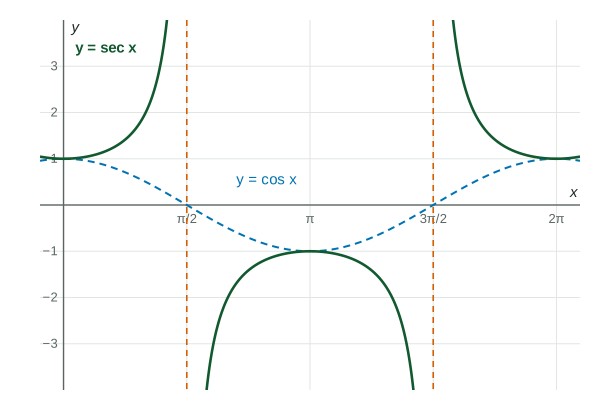
The graph of y = sec x for x from 0 to 2 pi, with the dashed cosine curve. Secant equals cosine where cosine is 1 or -1, has dashed vertical asymptotes at pi/2 and 3 pi/2 where cosine is 0, and never takes values between -1 and 1.
Secant is the reciprocal of cosine: equal to it at ±1\pm 1, with asymptotes where cosine is 00. LevlPrep original diagram.

Part 5 · Step by step

How it works, step by step

  1. Take reciprocals of cos⁡\cos, sin⁡\sin and tan⁡\tansec⁡x=1cos⁡x\sec x = \frac{1}{\cos x}, csc⁡x=1sin⁡x\csc x = \frac{1}{\sin x}, cot⁡x=cos⁡xsin⁡x\cot x = \frac{\cos x}{\sin x}
  2. A denominator is 00a vertical asymptote: sec⁡\sec where cos⁡x=0\cos x = 0, csc⁡\csc and cot⁡\cot where sin⁡x=0\sin x = 0
  3. cos⁡x\cos x or sin⁡x\sin x equals ±1\pm 1the reciprocal equals it there: a turning point of sec⁡\sec or csc⁡\csc
  4. |cos⁡x|≤1|\cos x| \le 1 and |sin⁡x|≤1|\sin x| \le 1|sec⁡x|≥1|\sec x| \ge 1 and |csc⁡x|≥1|\csc x| \ge 1, so neither takes values strictly between −1-1 and 11

Part 6 · Key ideas

Key ideas

  • Pair them by the letter they do not share: sec⁡\sec goes with cos⁡\cos, csc⁡\csc with sin⁡\sin.
  • sec⁡\sec has asymptotes where cos⁡x=0\cos x = 0; csc⁡\csc and cot⁡\cot where sin⁡x=0\sin x = 0.
  • Where cos⁡x\cos x decreases and stays positive, sec⁡x\sec x increases: reciprocals move the opposite way.
  • sec⁡\sec and csc⁡\csc have period 2π2\pi and range (−∞,−1]∪[1,∞)(-\infty, -1] \cup [1, \infty); cot⁡\cot has period π\pi and range (−∞,∞)(-\infty, \infty).

Part 7 · Misconception

A common mistake

The wrong idea: csc⁡x\csc x is the reciprocal of cos⁡x\cos x, because both start with c.

What actually happens: csc⁡x=1sin⁡x\csc x = \frac{1}{\sin x} and sec⁡x=1cos⁡x\sec x = \frac{1}{\cos x}. Each pairs with the function whose name it does not start like.

Part 8 · Check yourself

Check yourself

Exam-style questions. Anything you miss goes into your review queue.

Graph

The graph of y=sec⁡xy = \sec x, with y=cos⁡xy = \cos x dashed

π/2π3π/22π−4−3−2−11234xyy = sec xy = cos x (dashed)

1. Using the graph or the unit circle, find the exact value of sec⁡2π3\sec\frac{2\pi}{3}.

No calculator. Type the exact value (a fraction, π, e or a root is fine).

Show the answer

sec⁡2π3\sec\frac{2\pi}{3}=1cos⁡(2π/3)= \frac{1}{\cos(2\pi/3)}=1−1/2= \frac{1}{-1/2}=−2= -2. The graph of secant is below −1-1 on (π2,3π2)\left(\frac{\pi}{2}, \frac{3\pi}{2}\right), where cosine is negative.

  • Answer: -2

2. What is the range of y=sec⁡xy = \sec x?

  1. (−∞,−1]∪[1,∞)(-\infty, -1] \cup [1, \infty)
  2. [−1,1][-1, 1]
  3. (−∞,∞)(-\infty, \infty)
  4. [1,∞)[1, \infty)
Show the answer

cos⁡x\cos x is between −1-1 and 11, so its reciprocal has absolute value at least 11: sec⁡x≥1\sec x \ge 1 where cosine is positive and sec⁡x≤−1\sec x \le -1 where it is negative. On the graph, no part of the secant curve lies strictly between −1-1 and 11.

  • Correct: (−∞,−1]∪[1,∞)(-\infty, -1] \cup [1, \infty): Right: the reciprocal of a number between −1-1 and 11 is at least 11 in size.
  • [−1,1][-1, 1]: That is the range of cosine; secant takes the reciprocals of those values.
  • (−∞,∞)(-\infty, \infty): Secant never takes values like 00 or 12\frac{1}{2}: 1cos⁡x=12\frac{1}{\cos x} = \frac{1}{2} would need cos⁡x=2\cos x = 2.
  • [1,∞)[1, \infty): Where cos⁡x<0\cos x < 0, the secant branches open downward, with outputs at most −1-1.

3. Using the graph, which statement about sec⁡x\sec x near x=π2x = \frac{\pi}{2} is true?

  1. limx→π/2−sec⁡x\lim_{x \to \pi/2^-} \sec x=∞= \infty
  2. limx→π/2−sec⁡x\lim_{x \to \pi/2^-} \sec x=−∞= -\infty
  3. limx→π/2−sec⁡x\lim_{x \to \pi/2^-} \sec x=0= 0
  4. limx→π/2−sec⁡x\lim_{x \to \pi/2^-} \sec x=1= 1
Show the answer

Just left of π2\frac{\pi}{2}, cos⁡x\cos x is a small positive number, so 1cos⁡x\frac{1}{\cos x} is a large positive number: limx→π/2−sec⁡x\lim_{x \to \pi/2^-} \sec x=∞= \infty. From the right, cos⁡x\cos x is small and negative, and the limit is −∞-\infty.

  • Correct: limx→π/2−sec⁡x\lim_{x \to \pi/2^-} \sec x=∞= \infty: Right: the reciprocal of a small positive number is large and positive.
  • limx→π/2−sec⁡x\lim_{x \to \pi/2^-} \sec x=−∞= -\infty: That is the behavior from the right, where cosine is negative.
  • limx→π/2−sec⁡x\lim_{x \to \pi/2^-} \sec x=0= 0: Cosine approaches 00; its reciprocal grows without bound instead.
  • limx→π/2−sec⁡x\lim_{x \to \pi/2^-} \sec x=1= 1: sec⁡0=1\sec 0 = 1 is the bottom of the branch, not its behavior near the asymptote.

Table

Sine and cosine of four angles

Exact values of sin θ and cos θ for selected angles θ, in radians
θ\theta (radians)π6\frac{\pi}{6}π4\frac{\pi}{4}π3\frac{\pi}{3}π2\frac{\pi}{2}
sin⁡θ\sin\theta12\frac{1}{2}22\frac{\sqrt{2}}{2}32\frac{\sqrt{3}}{2}11
cos⁡θ\cos\theta32\frac{\sqrt{3}}{2}22\frac{\sqrt{2}}{2}12\frac{1}{2}00

4. Using the table, find the exact value of csc⁡π4\csc\frac{\pi}{4}.

No calculator. Type the exact value (a fraction, π, e or a root is fine).

Show the answer

csc⁡π4\csc\frac{\pi}{4}=1sin⁡(π/4)= \frac{1}{\sin(\pi/4)}=12/2= \frac{1}{\sqrt{2}/2}=22= \frac{2}{\sqrt{2}}=2= \sqrt{2}.

  • Answer: 2\sqrt{2} ≈ 1.414

5. Rewrite cos⁡xcsc⁡x\cos x \csc x as a single trigonometric function of xx.

Type an expression for cos⁡xcsc⁡x=\cos x \csc x =.

Show the answer

cos⁡xcsc⁡x\cos x \csc x=cos⁡x⋅1sin⁡x= \cos x \cdot \frac{1}{\sin x}=cos⁡xsin⁡x= \frac{\cos x}{\sin x}=cot⁡x= \cot x.

  • Answer: cos⁡xcsc⁡x=\cos x \csc x = cot⁡(x)\cot(x)

Part 9 · Summary

Summary

sec⁡x=1cos⁡x\sec x = \frac{1}{\cos x}, csc⁡x=1sin⁡x\csc x = \frac{1}{\sin x} and cot⁡x=cos⁡xsin⁡x\cot x = \frac{\cos x}{\sin x}. Each has vertical asymptotes where its denominator is 00. Secant and cosecant equal their partners at ±1\pm 1 and never take values strictly between −1-1 and 11; cotangent takes every real value and has period π\pi.

Part 10 · Up next

What comes next

Part 11 · Connections

Connections