Three more trigonometric functions come from the ones you know by taking reciprocals. They are not new ideas, just names for quotients that keep appearing: the length of a wire, the distance along a sloped beam, the rewriting steps in the next topic. Knowing them by sight makes the algebra shorter.
The definitions
For any angle where the denominator is not :
Secant goes with cosine and cosecant goes with sine. A quick check: each pairs with the function whose name it does not start like. Cotangent is the reciprocal of tangent, so it is cosine over sine.
Worked example 1. Find , and .
, so .
, so . The sign carries over: a reciprocal has the same sign as the number.
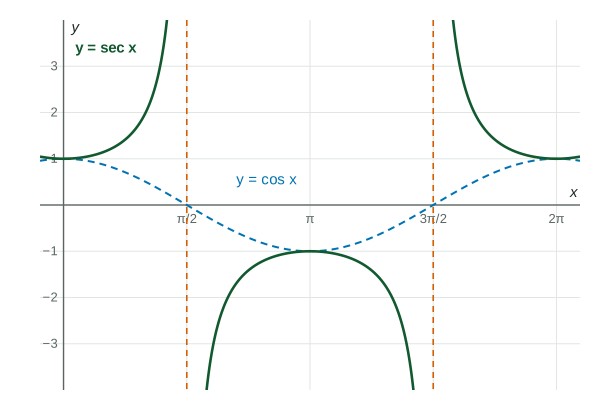
Where or , equals it: the reciprocal of is . These are the turning points of the secant branches.
Where , is undefined: a vertical asymptote. Near it, is a tiny number, so is huge, with the same sign as . For example and .
Where is positive and decreasing, is positive and increasing. Reciprocals of positive numbers move the opposite way.
Figure 1. (solid) and (dashed). LevlPrep original diagram.
The graph of is built from in the same way: turning points where , asymptotes where . The graph of looks like a tangent graph reflected and shifted: it falls on each branch, has zeros where and asymptotes where .
All six side by side
Function
Definition
Period
Vertical asymptotes
Range
-coordinate
none
-coordinate
none
Why the ranges skip : , and dividing by a number of size at most gives a number of size at least .
Rewriting with sines and cosines
When an expression mixes the six functions, write everything in terms of and , simplify the fraction, then name what is left. This is the main skill the next topic builds on.
Worked example 2. Rewrite and as single trigonometric functions.
.
, wherever and .
Common slips
Pairing with . Cosecant is .
Confusing the reciprocal with the inverse. returns a number; returns an angle.
Putting the asymptotes of where . They come from the zeros of its own denominator, .