A polar function describes a curve by distance and direction. This topic asks how that distance changes as the direction turns. The tools are the same ones you used in Unit 1: average rates of change, secant lines, increasing and decreasing. The new twist is the sign of .
Average rate of change of
The input is the angle and the output is , so the average rate of change of on is
measured in units of per radian. It is the slope of the secant line through and on the graph of against .
Worked example 1. For , find the average rate of change of on and say what it means.
and .
Meaning: as the angle turns from to , falls by about units per radian on average. Because stays positive on this interval, the curve moves toward the origin.
As with any function, an average rate gives estimates. Between two known values, the point on the secant line estimates : halfway in angle, halfway in . Comparing average rates on equal intervals shows whether the rate of change of is increasing or decreasing.
Toward or away from the origin
The distance from the origin to the point is , not . So "is increasing" and "is the curve moving away from the origin" are different questions. Put the sign of and its direction of change together:
| is | and is | so is | the curve is moving |
|---|---|---|---|
| positive | increasing | increasing | away from the origin |
| positive | decreasing | decreasing | toward the origin |
| negative | decreasing | increasing | away from the origin |
| negative | increasing | decreasing | toward the origin |
A quick test: if moves away from on the graph of against , the curve moves away from the origin. If moves toward , the curve comes back.
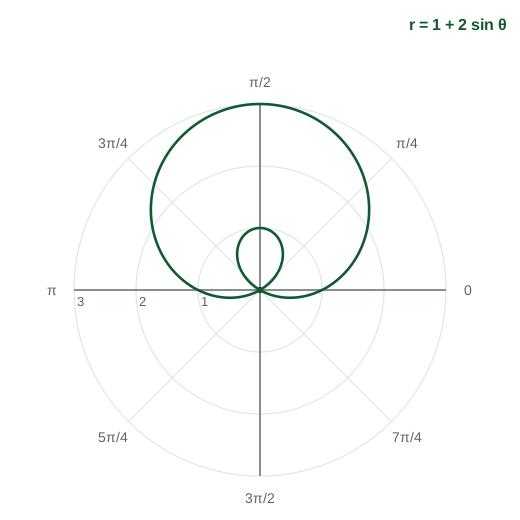
Worked example 2. For (Figure 1), is the distance from the origin increasing or decreasing on ?
Farthest and closest points
The curve is farthest from the origin where is largest, and touches the origin where . Read them from the graph of against : the highest peak and the lowest valley both count, because a valley at is units out.
Worked example 3. For , find the farthest point from the origin.
ranges from (at ) to (at ). The largest is , at : the point
Saying it in words
Name the function, the interval and both facts: "On , is negative and decreasing, so the distance between the point on the curve and the origin is increasing." For rates on equal intervals: "The average rates of change of decrease, so the rate of change of is decreasing on ."
Common slips
- Saying the curve moves toward the origin just because decreases, without checking the sign of .
- Dividing by the wrong thing: the rate is change in over change in .
- Reading only the highest peak of for the farthest point and missing a deeper valley.