The exam expects exact values of sine and cosine at the angles you meet most often, with no calculator. This page shows how to get each one in a few seconds from two triangles and the signs of the quadrants, and how to use them on circles of any size.
The first quadrant: three triangles of hypotenuse 1
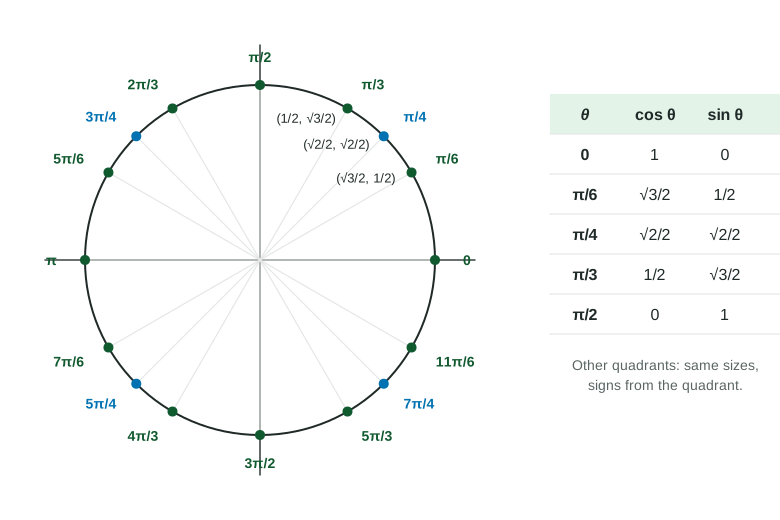
Put the angle () on the unit circle and drop a segment from the point to the -axis. You get a 30-60-90 triangle with hypotenuse 1. Its sides are divided by 2: the height (across from ) is and the base is . So the point is .
At () the same triangle stands on its other leg, and the coordinates swap: . At the 45-45-90 triangle with hypotenuse 1 has equal legs .
A quick check: the ray at is close to the -axis, so the point is far to the right and not very high. The bigger value, , is the -coordinate.
Every other quadrant: reference angles and signs
These are the special angles: every multiple of and . Each one makes the same triangle with the -axis as one of the three first-quadrant angles. The acute angle between the terminal ray and the -axis is the reference angle. The point has the same coordinates as at the reference angle, up to sign, and the quadrant gives the signs.
| Quadrant | Angles between | Reference angle of | Signs of |
|---|---|---|---|
| I | and | ||
| II | and | ||
| III | and | ||
| IV | and |
Worked example 1. Find and .
is between and : Quadrant III. Its reference angle is , where the point is .
In Quadrant III both coordinates are negative: and .
Worked example 2. Find .
Quadrant II, reference angle : the point is . Then
Angles outside first move by whole turns: has the same terminal ray as , so the same values.
Circles of any radius
On a circle of radius centered at the origin, the point at angle is the unit-circle point scaled by :
Worked example 3. A robot arm 2 meters long pivots at the origin. Its tip starts on the positive -axis and turns counterclockwise through . Where is the tip?
Quadrant III, reference angle : and .
Scale by 2: the tip is at
These exact values are the raw material for the graphs in the next topic and for every no-calculator model in the rest of the unit, so practice until they come without thinking.