Rectangular coordinates say how far to go right and how far to go up. Polar coordinates say how far to go and in which direction. Both name the same points; each is easier for some jobs. This page sets up the polar system, converts in both directions, and uses it to write complex numbers in polar form.
The polar grid
Start at a point called the pole (the origin) and draw a ray to the right, the polar axis (the positive -axis). The point is found in two moves:
- Turn to the angle , measured counterclockwise from the polar axis, as for an angle in standard position.
- Move units along that ray. If is negative, move units in the opposite direction, backward through the pole.
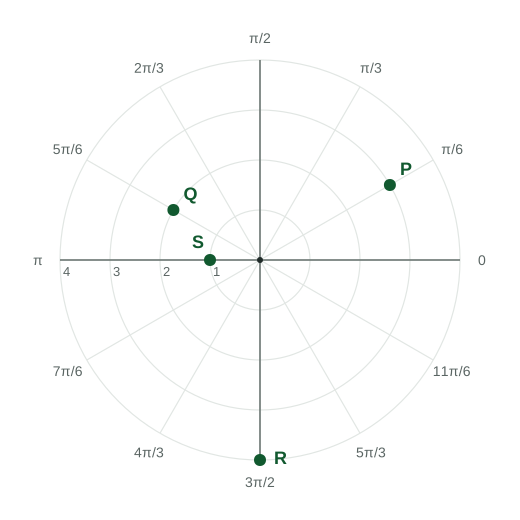
The grid has circles (all points with the same ) and rays (all points with the same ), as in Figure 1.
One point, many names
In rectangular coordinates every point has one name. In polar coordinates it has infinitely many:
- Adding a full turn changes nothing: and are the same point.
- Reversing direction twice changes nothing: and are the same point.
- The pole is for every .
For example, Q
Converting between the systems
The point lies on a circle of radius , so the circle facts from Topic 3.3 give the conversions.
| Direction | Formulas | Watch out for |
|---|---|---|
| Polar to rectangular | , | a negative flips both signs |
| Rectangular to polar | , | the quadrant of the angle |
| Equations | replace , and with , and | divide only by quantities that are not |
Worked example 1. Convert to rectangular coordinates.
The point is , in Quadrant IV: the ray points into Quadrant II, and the negative sends the point the other way.
Worked example 2. Convert to polar coordinates with and .
.
. The inverse gives , in Quadrant I. But is in Quadrant III, so add : .
The point is . Check:
Equations convert the same way. The circle becomes , or just . The line becomes , so .
Complex numbers in polar form
The complex plane plots as the point : real part across, imaginary part up. Any point has polar coordinates, so
This is the polar form of a complex number. is its distance from .
Worked example 3. Write in polar form.
The point is , in Quadrant IV. . , reference angle , so (or ).
Common slips
- Writing instead of .
- Trusting in Quadrants II and III. Draw the point and add when it is on the left.
- Reporting instead of .