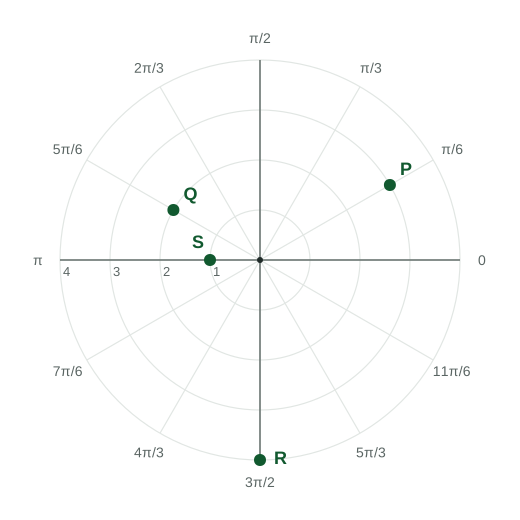
A point in polar coordinates (r, θ) is r units from the pole in the direction θ .
Practice 1: Procedural and Symbolic FluencyPractice 2: Multiple Representations
Part 1 · Hook
Why this matters
An air traffic radar does not report a plane's and . It reports how far away the plane is and in which direction. Distance and direction are a second way to name every point in the plane, and for anything that spins or sweeps, it is the natural one.
Part 2 · Before you start
What this builds on
Part 3 · Prerequisite check
Quick check before you start
1. What is ?
Show the answer
is in Quadrant II with reference angle , so its cosine is .
Correct: :
:
:
:
2. What is ?
Show the answer
The angle in with tangent is .
Correct: :
:
:
:
Part 4 · See it
See it first
A polar grid: circles of constant distance and rays of constant angle . P is . LevlPrep original diagram.
Part 5 · Step by step
How it works, step by step
Pick a distance and an angle →the point : turn to , then go units out from the pole
Use the circle of radius → and
Go back from → and , with the quadrant checked
Add to , or negate and add →the same point gets another name
Part 6 · Key ideas
Key ideas
means: face the direction , then move units. A negative moves backward through the pole.
, and convert between the two systems.
gives an angle in Quadrant I or IV; if the point is in Quadrant II or III, add .
A complex number is the point , so it has a polar form .
Part 7 · Misconception
A common mistake
The wrong idea: The polar angle of is .
What actually happens: only returns angles in Quadrants I and IV. is in Quadrant II, so the angle is .
Part 8 · Check yourself
Check yourself
Exam-style questions. Anything you miss goes into your review queue.
Diagram
Four points on a polar grid
The circles have radius , , and , and the rays are apart, measured counterclockwise from the polar axis (the positive -axis).
LevlPrep original diagram.
1. Which polar coordinates name point Q in the diagram?
Show the answer
Q is on the circle of radius , on the ray (five steps of from the polar axis). Polar coordinates list the distance first, then the angle: .
Correct: : Right: distance , angle .
: The order is : distance first, then angle.
: The ray at is in Quadrant I; Q is in Quadrant II.
: A negative points the opposite way, into Quadrant IV.
2. What are the rectangular coordinates of point P in the diagram?
Show the answer
P is in polar coordinates. and .
Correct: : Right: , .
: This swaps sine and cosine; uses cosine.
: This is the point on the unit circle; multiply by .
: That is the polar form of P, not its rectangular coordinates.
Table
Four points in rectangular coordinates
Four points named by their rectangular coordinates (x, y)
Point
U
V
W
Z
3. Point U in the table has rectangular coordinates . Find for U in polar coordinates. Give an exact value.
No calculator. Type the exact value (a fraction, π, e or a root is fine).
Show the answer
.
Answer: ≈ 4.243
4. For point U, , which angle in goes with ?
Show the answer
, and . But U is in Quadrant II (, ), and only returns angles in Quadrants I and IV. Add : .
Correct: : Right: Quadrant II, reference angle .
: That is , which points into Quadrant IV, and it is not in .
: points into Quadrant IV; with that names .
: points into Quadrant I, where both coordinates are positive.
5. The point is in Quadrant I. Find its polar angle , in radians, correct to three decimal places.
Calculator allowed. Give the answer correct to three decimal places, in radians.
Show the answer
, and the point is in Quadrant I, so (calculator in radian mode).
Answer: 0.381 radians
Part 9 · Summary
Summary
A point in polar coordinates is units from the pole in the direction . Convert with , , and , checking the quadrant. Every point has many polar names, and a complex number can be written as .