Polar Function Graphs
A polar function r = f(θ) assigns a signed distance to every direction.
Part 1 · Hook
Why this matters
Part 2 · Before you start
What this builds on
Part 3 · Prerequisite check
Quick check before you start
1. Where is the polar point ?
- Quadrant III
- Quadrant I
- Quadrant II
- Quadrant IV
Show the answer
The angle points into Quadrant I, and moves backward through the pole into Quadrant III.
- Correct: Quadrant III:
- Quadrant I:
- Quadrant II:
- Quadrant IV:
2. What is the period of ?
Show the answer
The period of is .
- Correct: :
- :
- :
- :
Part 4 · See it
See it first
Part 5 · Step by step
How it works, step by step
- Let sweep from to the input of is the direction
- Read from the graph of against the output is the signed distance along that direction
- is the curve passes through the pole
- is negativethe point is drawn on the opposite ray, in the opposite quadrant
Part 6 · Key ideas
Key ideas
- A polar function gives a distance for each direction; the curve is all points .
- Each hump of the graph of against draws one loop or petal; zeros of are visits to the pole.
- and are roses: petals if is odd, if is even.
- is a limaçon: an inner loop if , a cardioid if , no loop if .
Part 7 · Misconception
A common mistake
The wrong idea: Where is negative, the curve is drawn in the quadrant the angle points to, just closer to the pole.
What actually happens: A negative sends the point backward through the pole, so it is drawn in the opposite quadrant. That is how the inner loop of ends up to the right of the pole.
Part 8 · Check yourself
Check yourself
Exam-style questions. Anything you miss goes into your review queue.
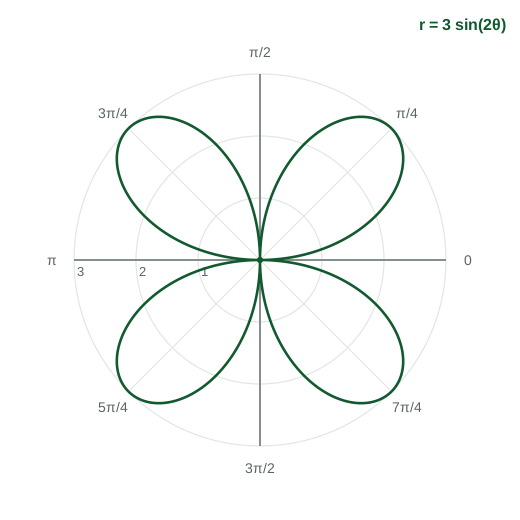
Graph
A polar rose, , and its graph of against
The first graph shows as a function of on rectangular axes, for . The second shows the same function drawn in the polar plane.
1. How many petals does the polar curve have?
Show the answer
For with even, the rose has petals: here . On the against graph there are four humps on , two above the axis and two below, and each hump draws one petal.
- Correct: : Right: is even, so petals.
- : Each hump of the graph draws a petal, and there are four humps on , including the two where .
- : That doubles the count twice. Four humps on draw four petals, each once.
- : An odd number of petals comes from an odd ; here .
2. For , in which quadrant are the points of the curve drawn?
- Quadrant IV
- Quadrant II
- Quadrant III
- Quadrant I
Show the answer
On the graph is below the axis, so . The angle points into Quadrant II, and a negative sends each point backward through the pole, into Quadrant IV. That petal is the one centered on the ray .
- Correct: Quadrant IV: Right: negative with an angle in Quadrant II lands in Quadrant IV.
- Quadrant II: That would need ; the graph is negative on this interval.
- Quadrant III: The point opposite a Quadrant II direction is in Quadrant IV, not III.
- Quadrant I: Quadrant I points come from , where .
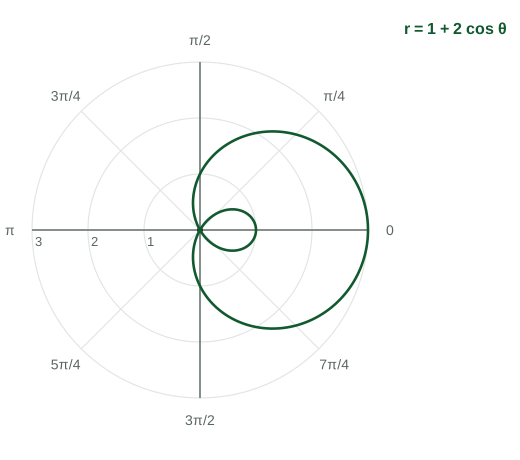
Graph
The polar function
The first graph shows against on rectangular axes, for . The second shows the same function in the polar plane.
3. For which in does the curve pass through the pole?
- and
- and
- and
Show the answer
when : and . On the graph these are where the curve crosses the -axis.
- Correct: and : Right: the two zeros of .
- and : These solve , where .
- : At , : the curve is unit from the pole.
- and : At and , .
4. Which interval of draws the small inner loop of ?
Show the answer
The inner loop is traced while , between the two zeros: on the graph is below the axis. The angles point left, but negative puts the points to the right of the pole, inside the big loop.
- Correct: : Right: the interval where is negative.
- : at and ; is still positive at the ends of this interval.
- : There : that piece is the upper half of the big loop.
- : There : that piece is the lower half of the big loop.
5. Which describes the graph of for ?
- A spiral that winds outward, two full turns
- A circle of radius
- A ray from the pole at angle
- A rose with petals
Show the answer
As sweeps around, keeps growing: each point is farther from the pole than the last, so the curve winds outward. From to the angle makes two full turns.
- Correct: A spiral that winds outward, two full turns: Right: growing distance with a turning angle makes a spiral.
- A circle of radius : A circle needs constant; here grows with .
- A ray from the pole at angle : A ray needs constant; here changes.
- A rose with petals: A rose needs to rise and fall back to ; here only grows.
Part 9 · Summary
Summary
Part 10 · Up next
What comes next
Part 11 · Connections