Rates of Change in Polar Functions
For a polar function, the average rate of change of r on [a, b] is (r(b) − r(a))/(b − a) units per radian, the slope of a secant line on the graph of r against θ .
Part 1 · Hook
Why this matters
Part 2 · Before you start
What this builds on
Part 3 · Prerequisite check
Quick check before you start
1. What is the average rate of change of on if and ?
Show the answer
- Correct: :
- :
- :
- :
2. Where is the point of at ?
- unit right of the pole
- unit left of the pole
- units left of the pole
- At the pole
Show the answer
; the angle points left and the negative reverses it, so the point is .
- Correct: unit right of the pole:
- unit left of the pole:
- units left of the pole:
- At the pole:
Part 4 · See it
See it first
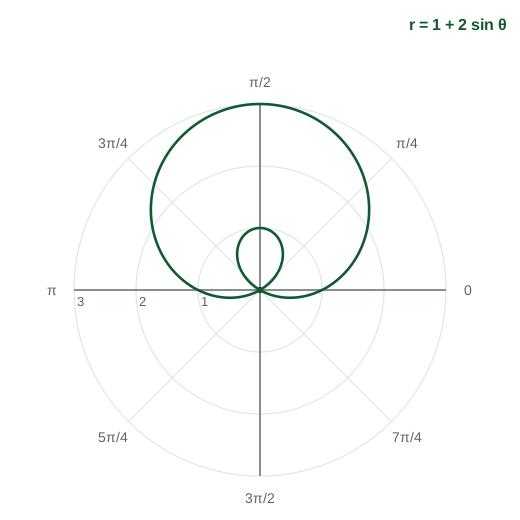
Part 5 · Step by step
How it works, step by step
- Pick two angles and is the average rate of change of , in units per radian
- The distance from the origin is it increases where and increasing, or and decreasing
- and decreasing, or and increasingthe distance from the origin decreases
- reaches a peaka point of the curve farthest from the origin nearby
Part 6 · Key ideas
Key ideas
- The average rate of change of on is : the slope of the secant line on the graph of against .
- Whether the curve moves toward or away from the origin depends on the sign of and on whether is increasing.
- Positive and increasing, or negative and decreasing: moving away. The other two cases: moving closer.
- The largest is the farthest point; is a visit to the origin.
Part 7 · Misconception
A common mistake
The wrong idea: When is decreasing, the curve is getting closer to the origin.
What actually happens: Only when . If is negative and decreasing, such as from to , then grows and the curve moves away from the origin.
Part 8 · Check yourself
Check yourself
Exam-style questions. Anything you miss goes into your review queue.
Graph
The polar function and its graph of against
The first graph shows against on rectangular axes, for . The second shows the same function in the polar plane.
1. Find the average rate of change of with respect to on . Give an exact value.
No calculator. Type the exact value (a fraction, π, e or a root is fine).
Show the answer
- Answer: ≈ 1.273
2. On the interval , how is the distance from the origin to the curve changing, and why?
- Decreasing, because is positive and decreasing
- Increasing, because is positive
- Decreasing, because is negative and increasing
- Increasing, because is decreasing
Show the answer
On the graph of , the values fall from at to at and stay positive. The distance from the origin is here, so it decreases: the curve moves back toward the pole.
- Correct: Decreasing, because is positive and decreasing: Right: positive and decreasing means a shrinking distance.
- Increasing, because is positive: Positive tells you the direction of the point, not whether is growing; here it is shrinking.
- Decreasing, because is negative and increasing: is still positive on this interval; it reaches only at .
- Increasing, because is decreasing: When is positive, a decreasing means the points get closer to the pole.
3. On which interval is increasing while the distance from the origin to the curve is decreasing?
Show the answer
On , rises from to : increasing but negative, so shrinks from to and the curve heads back to the pole.
- Correct: : Right: negative and increasing means a shrinking distance.
- : There rises from to and is positive, so the distance increases.
- : There rises from to and is positive, so the distance increases.
- : There is decreasing, from to .
Table
The reach of a garden sprinkler
A sprinkler turns counterclockwise. When its nozzle points in the direction radians, the water lands meters away. Use a calculator.
| (radians) | |||||
|---|---|---|---|---|---|
| (meters) |
4. Find the average rate of change of on , correct to three decimal places.
Calculator allowed. Give the answer correct to three decimal places, in meters per radian.
Show the answer
- Answer: 2.101 meters per radian
5. The average rate of change of is about meters per radian on and about meters per radian on . Which statement is supported?
- On the reach is increasing, and the rate of change of the reach is decreasing
- On the reach is decreasing, because the rates are getting smaller
- On the reach is increasing, and the rate of change of the reach is increasing
- On the reach is constant, because both rates are positive
Show the answer
- Correct: On the reach is increasing, and the rate of change of the reach is decreasing: Right: positive rates, getting smaller over equal intervals.
- On the reach is decreasing, because the rates are getting smaller: Smaller positive rates still mean the reach grows, just more slowly.
- On the reach is increasing, and the rate of change of the reach is increasing: The later rate is smaller, so the rate of change is decreasing.
- On the reach is constant, because both rates are positive: Positive rates mean the reach changes; it grows.
6. Which point of is closest to the origin?
- The point at , units from the origin
- The point at , units from the origin
- The point at , units from the origin
- The origin itself, at
Show the answer
is always positive, so the distance is itself. It is smallest where : , .
- Correct: The point at , units from the origin: Right: the least value of is .
- The point at , units from the origin: at is the farthest point.
- The point at , units from the origin: at is not the least value.
- The origin itself, at : at , so the curve never reaches the origin.
Part 9 · Summary
Summary
Part 10 · Up next
What comes next
Part 11 · Connections