Parametric Functions
A parametric function f(t) = (x(t), y(t)) sends each value of the parameter t to a point.
Beyond the exam. The AP® Precalculus exam does not test this unit. Many classes teach it, and it prepares you for calculus.
Part 1 · Hook
Why this matters
Part 2 · Before you start
What this builds on
Part 3 · Prerequisite check
Quick check before you start
1. If , what is ?
Show the answer
Substitute with parentheses:
- Correct: :
- :
- :
- :
2. The point is how far from the -axis, and on which side?
- 3 units, to the left
- 3 units, to the right
- 2 units, above
- 2 units, below
Show the answer
The first coordinate, , says 3 units left of the -axis.
- Correct: 3 units, to the left:
- 3 units, to the right:
- 2 units, above:
- 2 units, below:
Part 4 · See it
See it first
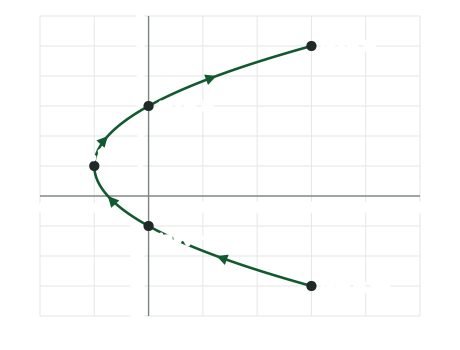
Part 5 · Step by step
How it works, step by step
- Pick a value of the parameter and give one point
- Let run through an intervalthe points trace a curve in the plane
- Plot the points in order of increasing the curve gets a direction of travel, shown with arrows
- Two values of give the same but different the curve is not the graph of a function of , even though and are both functions of
Part 6 · Key ideas
Key ideas
- A parametric function turns each input , the parameter, into a point of the plane.
- To sketch one, make a table: values of , then and , then plot the points in order of increasing and add arrows.
- The curve can go left, turn around, or cross itself. One with two -values means the curve is not the graph of a function of .
- If is easy to solve for , substitute into to write as a function of .
Part 7 · Misconception
A common mistake
The wrong idea: The graph of is the graph of against .
What actually happens: The curve plots against . The parameter is not on either axis: it only says which point comes when. The graph of against is a different picture.
Part 8 · Check yourself
Check yourself
Exam-style questions. Anything you miss goes into your review queue.
Table
A drone flight log
| (seconds) | 0 | 1 | 2 | 3 | 4 |
|---|---|---|---|---|---|
| (meters) | 2 | 5 | 6 | 5 | 2 |
| (meters) | 1 | 2 | 4 | 7 | 11 |
1. Where is the drone at seconds?
Show the answer
Read both rows in the column : and . The point is , 5 meters east and 7 meters north.
- Correct: : .
- : The coordinates are swapped; comes first.
- : is , from the wrong column.
- : is the time, not a coordinate.
2. Between which two readings does the drone first move west?
- Between and
- Between and
- Between and
- Between and
Show the answer
West means decreases. goes : it first falls from to , between and .
- Correct: Between and : drops from to here: the first move west.
- Between and : rises from to here, so the drone moves east.
- Between and : The drone does move west here, but it already did between and .
- Between and : rises from to , so this move is east.
3. The drone is at at two different times. What does that tell you?
- At the heights are and , so the path is not the graph of a function of
- The drone was at one and the same point at and again at
- The drone hovered in place from to before it moved west
- is not a function of , since two times share the output
Show the answer
At the drone is at and at at : one -value, two -values. The path in the -plane fails to be the graph of a function of , while and are still functions of .
- Correct: At the heights are and , so the path is not the graph of a function of : and share with different .
- The drone was at one and the same point at and again at : The -values differ ( and ), so they are different points.
- The drone hovered in place from to before it moved west: The drone went east to and back; it did not stay put.
- is not a function of , since two times share the output : Each has one , so is a function of ; repeated outputs are allowed.
4. A curve is given by and . Write as a function of .
Type an expression for .
Show the answer
Solve for : . Substitute into : .
- Answer:
5. A curve is given by and . What is at the point where the curve crosses the -axis?
No calculator. Type the exact value (a fraction, π, e or a root is fine).
Show the answer
On the -axis, : , so . Then .
- Answer: 10
6. Which function traces the same path as , , but in the opposite direction?
- for
- for
- for
- for
Show the answer
For , . With , runs from down to , so the path goes from to : the same points, backward.
- Correct: for : It starts at and ends at , the reverse of .
- for : is the parabola reflected across the -axis, a different path.
- for : With , runs from to : a different piece of the parabola.
- for : Swapping the coordinates gives , a parabola opening right.
Part 9 · Summary
Summary
Part 10 · Up next
What comes next
Part 11 · Connections