Parametric Functions Modeling Planar Motion
A particle moving in the plane has position (x(t), y(t)) at time t .
Beyond the exam. The AP® Precalculus exam does not test this unit. Many classes teach it, and it prepares you for calculus.
Part 1 · Hook
Why this matters
Part 2 · Before you start
What this builds on
Part 3 · Prerequisite check
Quick check before you start
1. On which interval is increasing?
Show the answer
is a parabola opening down with vertex at , so it increases to the left of .
- Correct: :
- :
- :
- :
2. A curve is , . Where is the point at ?
Show the answer
and , so the point is .
- Correct: :
- :
- :
- :
Part 4 · See it
See it first
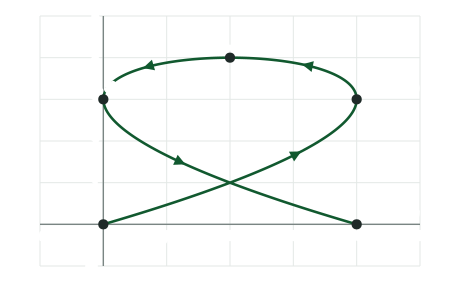
Part 5 · Step by step
How it works, step by step
- is increasing on an interval of timethe particle moves right during that time
- is decreasing on an interval of timethe particle moves down during that time
- changes from increasing to decreasingthe particle turns from moving right to moving left; that point is farthest right nearby
- One coordinate turns around while the other keeps changingthe particle is still moving, so it is not at rest
Part 6 · Key ideas
Key ideas
- In planar motion the position at time is . Read the horizontal motion from and the vertical motion from , one at a time.
- increasing: moving right. decreasing: moving left. increasing: moving up. decreasing: moving down.
- Where has a maximum the particle is farthest right; where has a maximum it is highest.
- A model is only good for the times the context allows, such as from launch until the ball lands.
Part 7 · Misconception
A common mistake
The wrong idea: When stops increasing and starts decreasing, the particle stops moving.
What actually happens: Only the horizontal motion turns around. If is still changing, the particle is moving straight up or down at that moment, so it is not at rest.
Part 8 · Check yourself
Check yourself
Exam-style questions. Anything you miss goes into your review queue.
Graph
Graphs of and for a moving particle
A particle moves in the plane with position for , where and . The graph shows each coordinate against time.
1. On which interval is the particle moving to the left?
Show the answer
The particle moves left where is decreasing. The graph of falls from at to at .
- Correct: : decreases on : left.
- : increases on , so the particle moves right.
- : decreases on ; that is when the particle moves down.
- : increases on ; that is when it moves up.
2. Where is the particle when it is highest?
Show the answer
The particle is highest where is largest: . Its position then is
- Correct: : At : , .
- : The coordinates are swapped; comes first.
- : is the point at , where the particle is farthest right, not highest.
- : is the point at , after the particle has started down.
3. On which interval is the particle moving left and down at the same time?
Show the answer
Left needs decreasing, on . Down needs decreasing, on . Both hold on the overlap, .
- Correct: : The overlap of and is .
- : On , is still increasing, so the particle moves left and up.
- : On , increases again: right and down.
- : This is the whole time it moves left, but for it is moving up.
4. At , changes from increasing to decreasing. Is the particle at rest at ?
- No: is still increasing then, so the particle is moving up
- Yes: stops changing, so the particle stops
- Yes: the particle is at its highest point then
- No: is still increasing at
Show the answer
Only the horizontal motion turns around at . increases until , so at the particle is still rising. It is not at rest.
- Correct: No: is still increasing then, so the particle is moving up: The vertical motion continues: increases on .
- Yes: stops changing, so the particle stops: A stop needs both coordinates to stop changing; keeps increasing.
- Yes: the particle is at its highest point then: The highest point is at , where .
- No: is still increasing at : reaches its largest value at ; it is turning around, not still increasing.
5. How does the graph of against differ from the path of the particle?
- The graph of shows when the particle moves right or left; the path shows where it goes
- They are the same picture drawn with different labels on the axes
- The graph of shows the path, and the path shows the time
- The graph of shows where the particle is highest
Show the answer
The graph of puts time across and horizontal position up, so its rises and falls show right and left motion. The path plots against and leaves time out.
- Correct: The graph of shows when the particle moves right or left; the path shows where it goes: Against : direction in . In the plane: the path.
- They are the same picture drawn with different labels on the axes: The axes differ ( and versus and ), so the shapes usually differ too.
- The graph of shows the path, and the path shows the time: The path is against ; time is not on either of its axes.
- The graph of shows where the particle is highest: Height is ; the graph of says nothing about it.
6. A particle moves with and for . What is its -coordinate when it is at its lowest point?
No calculator. Type the exact value (a fraction, π, e or a root is fine).
Show the answer
- Answer: 1
Part 9 · Summary
Summary
Part 10 · Up next
What comes next
Part 11 · Connections