A parametric function is a natural way to describe something moving around a flat surface: a puck on ice, a robot on a floor, a ball in flight seen from the side. The parameter is time, and the two coordinates tell you where the object is at each moment. This page shows how to read the motion, one direction at a time.
Position at time
In planar motion an object's position at time is the point . The function tracks the horizontal position and tracks the vertical position. The two can be described, graphed and analyzed separately, then put back together.
| On an interval of time | The particle moves |
|---|---|
| increasing | right |
| decreasing | left |
| increasing | up |
| decreasing | down |
Combine one row from each pair. If is decreasing and is increasing, the particle moves left and up.
Turning points
Where changes from increasing to decreasing, the particle stops going right and starts going left: that point is a relative maximum of , the particle's farthest right position nearby. In the same way a maximum of is a highest point and a minimum is a lowest point.
A turning point of one coordinate is not a stop. At a maximum of , if is still changing, the particle is moving straight up or down for that moment. It is at rest only when neither coordinate is changing.
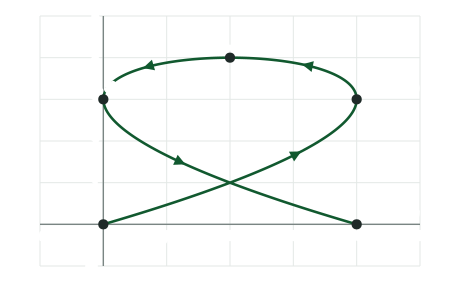
Worked example 1. A particle moves with and for . Describe its motion.
Horizontal. From a table or graph, , , , , and increases on , decreases on and increases on . So the particle moves right, then left, then right.
Vertical. increases on and decreases on . So it moves up, then down.
Together. On : right and up. On : left and up. On : left and down. On : right and down. The highest point is at :
Motion with a calculator: a thrown ball
Seen from the side, a ball thrown from a height of 1.5 meters can be modeled with meters across and
Worked example 2. When does the ball land, and how far away?
It lands when . Graph and find its zeros: and . A time before the throw makes no sense, so the ball lands at seconds. Store that value, then compute from the stored value:
The model describes the ball only for . After that the formula gives negative heights, which a ball on the ground cannot have.
Two graphs and one path
Three pictures go with planar motion: the graph of against , the graph of against , and the path in the -plane. The first two tell you when each coordinate rises or falls, so they answer "which way is it moving?". The path answers "where does it go?". Read the direction questions from the graphs against , then check your answer on the path.